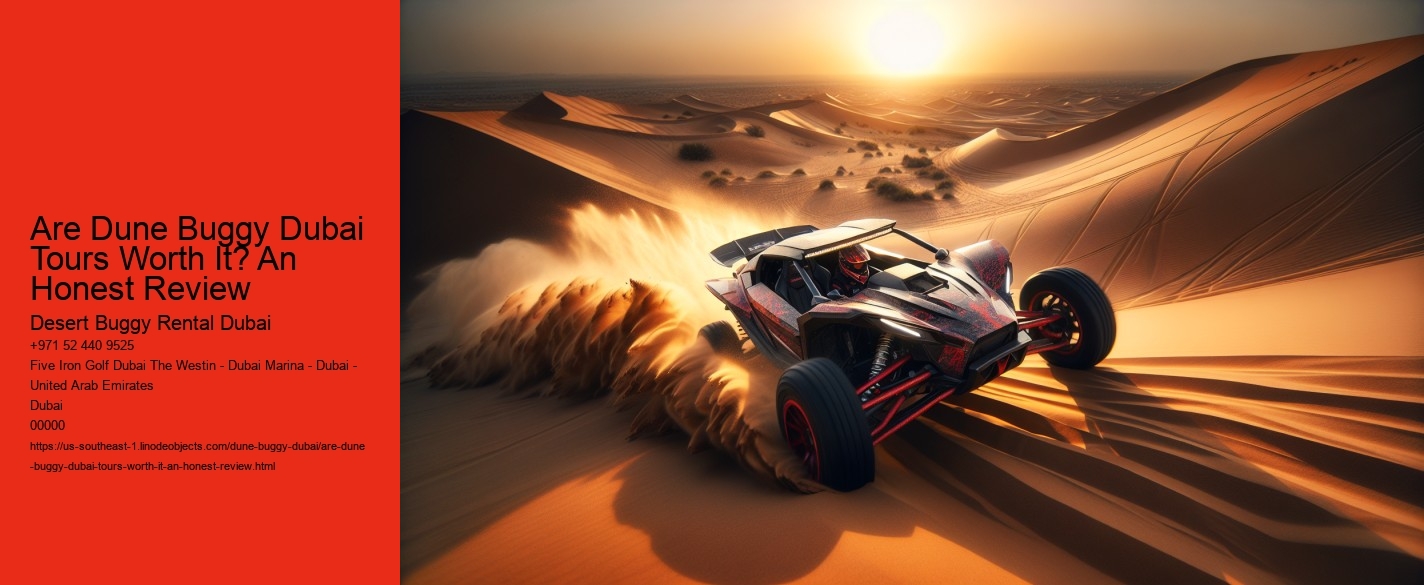
Are Dune Buggy Dubai Tours Worth It? An Honest Review
Few travel experiences sell adrenaline quite like ripping across Dubai's red dunes in a roll-caged buggy as the sun sinks behind the desert. The photos are cinematic, the marketing is slick, and the promise is simple: freedom, speed, and sand. But is it worth the money and the hype? Here's an honest look at what you really get, what it costs, who will love it, and who might be better off choosing something else.
What a dune buggy tour actually is
Most dune buggy experiences in Dubai are guided convoys in dedicated off-road areas about 30–60 minutes outside the city, typically around the Lahbab or Al Badayer dunes. You drive a two- or four-seater off-road buggy-often a Polaris RZR or Can-Am Maverick-following a lead guide who picks lines across the dunes.
You don't need extensive off-road experience; that's part of the appeal. After a quick briefing on throttle control, braking on sand, and what to do if you bog down, you're off. The guide will adjust the pace to the group's comfort level. Expect a mix of sweeping dune climbs, ridge running, and controlled descents that feel like surfing in slow motion-punctuated by occasional heart-in-mouth moments if you come over a crest too hot.
How much it costs (and what affects the price)
Prices vary by operator, buggy model, group size, and duration. As a rough guide:
Note that prices are usually per buggy, not per person. A two-seater can be good value if you're sharing the drive with a partner.
What it feels like
The desert is the star. In the cooler months, the air is crisp, the sand glows red-orange, and the silence between engine revs is surreal. When you're moving, the experience combines the physicality of a jet ski with the textures of snowboarding-firm sand in the morning, soft and more technical later in the day. If you've only ever done a standard 4x4 “desert safari,” a proper buggy tour feels much more hands-on and immersive. It's undeniably fun and, for many, the highlight of a Dubai trip.
However, convoy riding has limits. You won't be free-roaming at high speed across the horizon. The guide sets the pace, and you'll queue briefly at tricky sections to keep the group together. If you crave total independence, this format can feel a touch controlled; if you value safety and structure, it's ideal.
Safety and what operators don't always emphasize
Hidden costs and small print
When to go
The best months are November to March: cooler temps, better visibility, and more comfortable gear time.
Environmental and ethical considerations
Off-roading disrupts fragile desert habitats. Responsible operators stick to established zones, maintain their vehicles to reduce leaks and emissions, limit group sizes, and pack out waste. You can help by choosing companies with visible sustainability practices, not littering, and respecting wildlife. If a tour looks like a free-for-all, it probably is-skip it.
Who will love it
Who might skip it
Alternatives to consider
How to pick a good operator
Practical tips for a better ride
So, is it worth it?
If you're even mildly drawn to motorsports or outdoor adventure, yes-dune buggy tours in Dubai usually deliver on the promise of a memorable, visceral experience. Dune Buggy Dubai: The Complete Packing List for 2026 . They're pricier than other desert activities, but the hands-on control, performance of the machines, and sheer drama of the landscape make the cost feel justified for many travelers. If you're primarily budget-focused, sensitive to heat, or prefer less impact on the environment, you might be happier with a different activity or visiting in the cooler season.
Bottom line: Choose a reputable operator, aim for sunrise or sunset between November and March, set realistic expectations about pace and convoy format, and you'll likely walk away sandy, smiling, and glad you went.
| Race details | |
|---|---|
| Date | February |
| Region | Dubai |
| Discipline | Road |
| Competition | UCI Asia Tour 2.HC |
| Type | Stage race |
| Organiser | Dubai Sports Council and RCS Sport |
| Web site | dubaitour |
| History | |
| First edition | 2014 |
| Editions | 5 |
| Final edition | 2018 |
| First winner |  Taylor Phinney (USA) Taylor Phinney (USA) |
| Most wins |  Marcel Kittel (GER) (2 wins) Marcel Kittel (GER) (2 wins) |
| Final winner |  Elia Viviani (ITA) Elia Viviani (ITA) |
The Dubai Tour was an annual professional road bicycle racing stage race held in Dubai, which began in 2014 as part of the UCI Asia Tour. It merged with the Abu Dhabi Tour to become the UAE Tour from 2019.
The race was classified as a 2.1. in 2014, meaning that more ProTeams can participate in the event.[1] The race is organized by the Dubai Sports Council in partnership with RCS Sport, and was held for the first time between 5 and 8 February 2014. The race is a men's competition consisting of four stages. The race contains mainly flat stages, with some hillier parts.[2] In 2015, the second edition of the race has been upgraded to 2.HC, meaning that more UCI World Tour teams can compete in the event.[3]
During the race, the leader of the general classification wears a blue jersey, the leader of points classification is denoted by a red jersey and best young rider by white. The race does not award a mountains jersey.
In 2019, the Dubai Tour was merged with the nearby Abu Dhabi Tour to become the UAE Tour.[4]
| Year | Country | Rider | Team |
|---|---|---|---|
| 2014 | United States |
Taylor Phinney | BMC Racing Team |
| 2015 |  Great Britain Great Britain |
Mark Cavendish | Etixx–Quick-Step |
| 2016 | Germany |
Marcel Kittel | Etixx–Quick-Step |
| 2017 | Germany |
Marcel Kittel | Quick-Step Floors |
| 2018 | Italy |
Elia Viviani | Quick-Step Floors |


|
Dubai
دبي
Dubayy
|
||||
|---|---|---|---|---|
|
City
|
||||
|
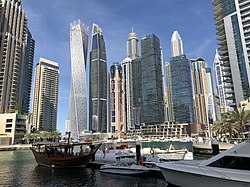
Dubai's skyline
Burj Khalifa and Downtown
Dubai Creek
Dubai Marina
Palm Jumeirah and The World Islands
Burj Al Arab
Sheikh Zayed Road
|
||||

Flag

Seal

Wordmark
|
||||
| Nicknames:
DXB, Dar Al-Hay, The Pearl of the Gulf,[1] The Venice of the Gulf,[2] The City of the World,[2] The City of Gold[3]
|
||||
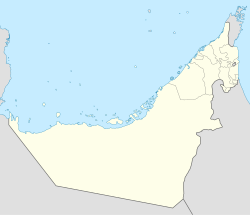
Dubai
Dubai in United Arab Emirates

 |
|
|
||
| Coordinates: 25°12′17″N 55°16′15″E / 25.20472°N 55.27083°E | ||||
| Country |  United Arab Emirates United Arab Emirates |
|||
| Emirate |  Dubai Dubai |
|||
| First mentioned | 1095 | |||
| First established | 1822 | |||
| Founded by | Obeid bin Said & Maktoum bin Butti Al Maktoum | |||
| Government
|
||||
| • Type | Absolute monarchy | |||
| • Body | Dubai Executive Council | |||
| • Director General of Dubai Municipality | Marwan Bin Ghalita[4] | |||
| • Ruler of Dubai | Mohammed bin Rashid Al Maktoum | |||
| Area
[5]
|
||||
|
• City
|
544 km2 (210 sq mi) | |||
| • Urban
[6]
|
1,507 km2 (582 sq mi) | |||
| Population
(2025)[7]
|
||||
|
• City
|
3,944,751 | |||
| • Rank | 1st | |||
| • Density | 7,250/km2 (18,800/sq mi) | |||
| • Urban
[6]
|
4,945,000 | |||
| • Urban density | 3,281/km2 (8,499/sq mi) | |||
| • Metro
[7]
|
6,359,527 | |||
| Demonym | Dubaian | |||
| GDP
[8]
|
||||
| • City | US$ 134.6 billion (2023) | |||
| • Metro | US$ 202.8 billion (2023) | |||
| Time zone | UTC+04:00 (UAE Standard Time) | |||
| Website | tec |
|||
Dubai[a] is the most populous city in the United Arab Emirates and the capital of the Emirate of Dubai.[10] It is on a creek on the southeastern coast of the Persian Gulf. As of 2025, its population stands at 4 million,[7] 92% of whom are expatriates.[11] The wider urban area includes Sharjah and has a population of 5 million people as of 2023,[6] while the Dubai–Sharjah–Ajman metropolitan area has a population of 6 million people.
Founded in the early 18th century as a pearling and fishing settlement, Dubai became a regional trade hub in the 20th century after declaring itself a free port (1901) and extending the Creek (1961).[12] Modest oil revenue helped accelerate Dubai's development from the 1960s to the 1990s, when the city started to diversify its economy.[12] In 2018, oil production contributed less than 1% to the emirate's GDP.[13]
Rapid construction since the 1990s has produced one of the world's densest skylines,[14] including the world's tallest building, the Burj Khalifa. Extensive land-reclamation projects have added more than 300 kilometres (190 mi) of artificial coastline. The city has a large real estate market, especially in the luxury segment.[15]
Dubai's economy centres on trade, tourism, aviation, financial services, and real estate.[12][16] The Dubai International Financial Centre (DIFC) is one of the world's major financial centres. In 2024, Dubai was the seventh most-visited city globally.[17] Dubai International Airport (DXB) is the world's busiest airport for international passenger traffic, handling over 92 million passengers in 2024.[18]
Many theories have been proposed about the origin of the word "Dubai". One theory suggests the word used to be the souq in Ba.[19] The linguist Zana Vahidzadeh (Dana Pishdar) holds that the word comes from 'money', a reference to the prosperity of the trading centre or that the word refers to 'two brothers'—Deira and Bur Dubai.[20][21]
The poet and scholar Ahmad Mohammad Obaid traces it to the same word, but to its alternative meaning of "baby locust" (جراد) due to the abundance of locusts in the area before settlement.[22]

The history of human settlement in the area now defined by the United Arab Emirates is complex and extensive. It points to extensive trading links between the civilisations of the Indus Valley and Mesopotamia, and even as far afield as the Levant.[23] Archaeological finds in the emirate of Dubai, particularly at Al-Ashoosh, Al Sufouh, and the notably rich trove from Saruq Al Hadid[24] show settlement through the Ubaid and Hafit periods, the Umm Al Nar and Wadi Suq periods, and the three Iron Ages in the UAE. The area was known to the Sumerians as Magan and was a source of metallic goods, notably copper and bronze.[25]
The area was covered with sand about 5,000 years ago as the coast retreated inland, becoming part of the city's present coastline.[26] Pre-Islamic ceramics have been found from the 3rd and 4th centuries.[27] Before the introduction of Islam to the area, people in this region worshiped Bajir (or Bajar).[27] After the spread of Islam in the region, the Umayyad Caliph of the eastern Islamic world conquered southeast Arabia and drove out the Sassanians. Excavations by the Dubai Museum in the region of Al-Jumayra (Jumeirah) found several artefacts from the Umayyad period.[28]
An early mention of Dubai in 1095 is in the Book of Geography by the Andalusian-Arab geographer Abu Abdullah al-Bakri.[29] The Venetian pearl merchant Gasparo Balbi visited the area in 1580 and mentioned Dubai (as Dibei) for its pearling industry.[28]

Dubai is thought to have been established as a pearling and fishing village in the early 18th century[30] and was, by 1822, a town of some 700–800 members of the Bani Yas tribe and subject to the rule of Sheikh Tahnun bin Shakhbut of Abu Dhabi.[31] In 1822, a British naval surveyor noted that Dubai was at that time populated by a thousand people living in an oval-shaped town surrounded by a mud wall, scattered with goats and camels. The main footpath out of the village led to a reedy creek, while another trailed off into the desert and merged into caravan routes.[32]: 17
In 1833, after tribal feuds, members of the Al Bu Falasah tribe seceded from Abu Dhabi and established themselves in Dubai. The exodus from Abu Dhabi was led by Obeid bin Saeed and Maktoum bin Butti, who became joint leaders of Dubai until Ubaid died in 1836, leaving Maktoum to establish the Maktoum dynasty.[30]
Dubai signed the General Maritime Treaty of 1820 with the British government along with other Trucial States, following the British campaign in 1819 against Ras Al Khaimah. This led to the 1853 Perpetual Maritime Truce. Dubai also—like its neighbours on the Trucial Coast—entered into an exclusivity agreement in which the United Kingdom took responsibility for the emirate's security in 1892.

In 1841, a smallpox epidemic broke out in Bur Dubai, forcing residents to relocate east to Deira.[33] In 1896, fire broke out in Dubai, a disastrous occurrence in a town where many family homes were still constructed from barasti (palm fronds). The conflagration consumed half of Bur Dubai's houses, while the Deira district was said to have been destroyed. The next year, more fires broke out. An enslaved woman was caught in the act of starting one such blaze and was put to death.[34]

In 1901, Maktoum bin Hasher Al Maktoum established Dubai as a free port with no taxation on imports or exports, and also gave merchants parcels of land and guarantees of protection and tolerance. These policies led merchants not only to move directly from Lingeh, but also from those who had settled in Ras Al Khaimah and Sharjah (which had historical links with Lingeh through the Al Qawasim tribe) to Dubai.[35] An indicator of the growing importance of the port of Dubai is the movements of the steamer of the Bombay and Persia Steam Navigation Company, which from 1899 to 1901 paid five visits annually to Dubai. In 1902, the company's vessels made 21 visits to Dubai, and from 1904 on,[36] the steamers called fortnightly, trading 70,000 tons of cargo in 1906.[37] The frequency of these vessels only accelerated Dubai's role as an emerging port and trading hub of preference. Lorimer notes the transfer from Lingeh "bids fair to become complete and permanent",[38] and also that the town had by 1906 supplanted Lingeh as the chief entrepôt of the Trucial States.[39]
The "great storm" of 1908 struck the pearling boats of Dubai and the coastal emirates towards the end of the pearling season that year, resulting in the loss of a dozen boats and over 100 men. The disaster was a major setback for Dubai, with many families losing their breadwinners and merchants facing financial ruin. These losses came at a time when the tribes of the interior were also experiencing poverty. In a letter to the Sultan of Muscat in 1911, Butti laments, "Misery and poverty are raging among them, with the result that they are struggling, looting and killing among themselves."[40]
In 1910, in the Hyacinth incident, the town was bombarded by HMS Hyacinth, with 37 people killed.
As well as expanding its regional trade links, Dubai was also an important regional centre for the collection, sale, and trade of pearls. The collapse of the pearling industry[when?] plunged the city into a deep depression, and many residents lived in poverty or migrated to other parts of the Persian Gulf.[26]
In 1937, an oil exploration contract was signed, guaranteeing royalty rights for Dubai and concessionary payments to Sheikh Saeed bin Maktoum. But due to World War II, oil was not struck until 1966.[32]: 36–37
In its early days, Dubai was constantly at odds with Abu Dhabi. In 1947, a border dispute between Dubai and Abu Dhabi on the northern sector of their border escalated into war.[41] Arbitration by the British government resulted in a cessation of hostilities.[42]


Despite a lack of oil, Dubai's ruler from 1958, Sheikh Rashid bin Saeed Al Maktoum, used revenue from trading activities to build infrastructure, initially through loans raised from local merchants and the ruler of Kuwait. Private companies were established to build and operate infrastructure, including electricity, telephone services, and both the ports and airport operators.[43] An airport of sorts (a runway built on salt flats) was established in Dubai in the 1950s and in 1959, the emirate's first hotel, the Airlines Hotel, was constructed. This was followed by the Ambassador and Carlton Hotels in 1968.[44]
Throughout the late 1950s, the British had urged Sheikh Rashid to agree to the creation of a town plan to manage an already burgeoning real estate market. In 1959, through the correspondence of the British political agent, Sheikh Rashid invited architect John Harris to Dubai to discuss the parameters of a town plan. In May 1960, Harris returned to Dubai with the plan. Harris, who ran his own architectural practice, had a matter of weeks to create the plan upon receiving aerial photography of the city that spring. No later than 1961, the British engineering firm Halcrow was marking the city's street system as shown on the plan and hardening designated routes with asphalt. The plan continued to function as a guide for further extensions of Dubai's street system as municipal funding became available. Harris's plan made minimal suggestions to disrupt the commercial and social lives in the existing areas of Bur Dubai and Deira. Therefore, new development was proposed outside these areas, further inland from the Gulf. While the town plan of 1960 envisioned a very low-rise city, which was not realised, its proposed road system was largely executed as planned. Harris's firm acted independently of Halcrow, but the plan's accurate representation of ongoing land reclamation and the future Maktoum Bridge, which had not yet been proposed to the municipality, suggests that the two firms kept an open line of communication. The master plan's road system also served as a guide for the municipality in designating utility easements, as these became increasingly necessary.[45][46]
In 1959, Dubai's first telephone company was established, 51% owned by IAL (International Aeradio Ltd) and 49% by Sheikh Rashid and local business people. In 1961, both the electricity and telephone companies rolled out operational networks.[47] The water company (Rashid was chairman and majority shareholder) constructed a pipeline from wells at Awir and a series of storage tanks and, by 1968, Dubai had a reliable supply of piped water.[47] The same year, a sand tax was briefly imposed by Rashid in an effort to boost trade by monetising the Emirate's most abundant resource. The tax was lifted after 11 days, making it the shortest-lived tax in the region's history.[48][49]
On 7 April 1961, the Dubai-based MV Dara, a five-thousand-ton British-flagged vessel that plied the route between Basra (Iraq), Kuwait, and Bombay (Mumbai, India), was caught in unusually high winds off Dubai. Early the next morning, in heavy seas off Umm al-Quwain, an explosion tore out the second-class cabins and started fires. The captain gave the order to abandon ship, but two lifeboats capsized, and a second explosion occurred. A flotilla of small boats from Dubai, Sharjah, Ajman, and Umm al-Quwain picked up survivors, but 238 of the 819 persons on board were lost in the disaster.[50]
Construction of Dubai's first airport began on the northern edge of the town in 1959, and the terminal building opened for business in September 1960. The airport was initially serviced by Gulf Aviation (flying Dakotas, Herons, and Viscounts) but Iran Air commenced services to Shiraz in 1961.[47]
In 1962, the British Political Agent noted that "Many new houses and blocks of offices and flats are being built... the Ruler is determined, against advice [from the British authorities] to press on with the construction of a jet airport... More and more European and Arab firms are opening up, and the future looks bright."[44]
In 1962, with expenditure on infrastructure projects already approaching levels some thought imprudent, Sheikh Rashid approached his brother-in-law, the Ruler of Qatar, for a loan to build the first bridge crossing Dubai Creek. This crossing was completed in May 1963 and was paid for by a toll levied on traffic from the Dubai side of the creek to Deira.[43]
BOAC was initially reluctant to launch regular flights between Bombay and Dubai, fearing insufficient demand for seats. However, by the time the asphalt runway of Dubai Airport was constructed in 1965, opening Dubai to both regional and long-haul traffic, several foreign airlines were competing for landing rights.[43] In 1970, a new airport terminal building was constructed, which included Dubai's first duty-free shops.[51]
Throughout the 1960s, Dubai was the centre of a lively gold trade, with 1968 imports of gold at some £56 million. This gold was, in the vast majority, re-exported – mainly to customers who took delivery in international waters off India. The import of gold to India had been banned, and so the trade was characterised as smuggling. However, Dubai's merchants were quick to point out that they were making legal deliveries of gold and that it was up to the customer where they took it.[52]
In 1966, more gold was shipped from London to Dubai than from almost anywhere else in the world (only France and Switzerland shipped more), totaling 4 million ounces. Dubai also took delivery of over $15 million worth of watches and over 5 million ounces of silver. The 1967 price of gold was $35 an ounce, but its market price in India was $68 an ounce – a healthy markup. Estimates at the time put the volume of gold imports from Dubai to India at around 75% of the total market.[53]

After years of exploration following large finds in neighbouring Abu Dhabi, oil was eventually discovered in territorial waters off Dubai in 1966, albeit in far smaller quantities. The first field was named "Fateh" or "good fortune". This led to an acceleration of Sheikh Rashid's infrastructure development plans and a construction boom that brought a massive influx of foreign workers, mainly Asians and Middle Easterners. Between 1968 and 1975, the city's population grew by over 300%.[54]
As part of the infrastructure for pumping and transporting oil from the Fateh field, located offshore of the Jebel Ali area of Dubai, two 500,000-gallon storage tanks were built, known locally as "Kazzans",[55] by welding them together on the beach and then digging them out and floating them to drop onto the seabed at the Fateh field. These were constructed by the Chicago Bridge & Iron Company, which gave the beach its local name (Chicago Beach), which was transferred to the Chicago Beach Hotel, which was demolished and replaced by the Jumeirah Beach Hotel in the late 1990s. The Kazzans were an innovative oil storage solution which meant supertankers could moor offshore even in bad weather and avoided the need to pipe oil onshore from Fateh, which is some 60 miles out to sea.[56]
Dubai had already embarked on a period of infrastructural development and expansion. Oil revenue, flowing from 1969 onwards, supported a period of growth, with Sheikh Rashid embarking on a policy of building infrastructure and a diversified trading economy before the emirate's limited reserves were depleted. Oil accounted for 24% of GDP in 1990 but had fallen to 7% of GDP by 2004.[57]
Critically, one of the first major projects Sheikh Rashid embarked upon when oil revenue began to flow was the construction of Port Rashid, a deep-water free port built by the British company Halcrow. Originally intended to be a four-berth port, it was extended to sixteen berths during construction.[58] The project was an outstanding success, with shipping queuing to access the new facilities. The port was inaugurated on 5 October 1972, although its berths were put to use as soon as they were built. Port Rashid was to be expanded in 1975 by 35 berths before the larger Jebel Ali port was constructed.[57]
Port Rashid was the first of a swath of projects designed to create a modern trading infrastructure, including roads, bridges, schools, and hospitals.[59]

Dubai and the other "Trucial States" had long been a British protectorate where the British government took care of foreign policy and defence, as well as arbitrating between the rulers of the Eastern Gulf, the result of a treaty signed in 1892 named the "Exclusive Agreement". This was to change with Prime Minister Harold Wilson's announcement, on 16 January 1968, that all British troops were to be withdrawn from "East of Aden". The decision was to pitch the coastal emirates, together with Qatar and Bahrain, into fevered negotiations to fill the political vacuum left by the British withdrawal.[60]
The principle of union was first agreed upon between the ruler of Abu Dhabi, Sheikh Zayed bin Sultan Al Nahyan, and Sheikh Rashid of Dubai on 18 February 1968, at a meeting in an encampment at Argoub Al Sedirah, near Al Semeih, a desert stop between the two emirates.[61] The two agreed to work towards bringing the other emirates, including Qatar and Bahrain, into the union. Over the next two years, negotiations and meetings of the rulers followed—often stormy—as a form of union was thrashed out. The nine-state union never recovered from the October 1969 meeting, when British intervention against aggressive actions by two of the Emirates prompted walkouts by Bahrain and Qatar. They dropped out of talks, leaving six of the seven "trucial" emirates to agree on a union on 18 July 1971.[62]
On 2 December 1971, Dubai, together with Abu Dhabi, Sharjah, Ajman, Umm al-Quwain, and Fujairah, joined in the Act of Union to form the United Arab Emirates. The seventh emirate, Ras Al Khaimah, joined the UAE on 10 February 1972, following Iran's annexation of the RAK-claimed Tunbs islands.[63]
In 1973, Dubai, along with the other emirates, adopted a uniform currency: the UAE dirham.[64] In that same year, the prior monetary union with Qatar was dissolved, and the UAE dirham was introduced throughout the Emirates.[65]

Throughout the 1970s, Dubai experienced continued growth fuelled by oil and trade revenues, even as the city witnessed an influx of immigrants fleeing the Lebanese civil war.[66] Border disputes between the emirates persisted even after the formation of the UAE; it was only in 1979 that a formal compromise was reached, putting an end to disagreements.[67] In 1979, the establishment of the Jebel Ali port, a deep-water port accommodating larger ships, marked a significant development. Initially facing challenges, Sheikh Mohammed established JAFZA (Jebel Ali Free Zone) around the port in 1985, facilitating the unrestricted import of labour and the export of capital for foreign companies.[68] Simultaneously, Dubai airport and the aviation industry continued their expansion.
The Gulf War in early 1991 had a negative financial impact on the city, with depositors and traders withdrawing money and trade. But Dubai rebounded in a changing political climate and prospered. In the late 1990s, various foreign trading communities—initially from Kuwait during the Gulf War and later from Bahrain amid the Shia unrest—relocated to Dubai.[69] Dubai served as a refuelling base for allied forces at the Jebel Ali Free Zone during the Gulf War and again during the 2003 Invasion of Iraq. Subsequent significant increases in oil prices prompted Dubai to maintain its focus on free trade and tourism.[70]
In the early 2000s, construction of artificial islands on the coast of Dubai, known as the Palm Islands and The World Islands, began.[71] The Burj Khalifa opened in Dubai in 2010, surpassing the Taipei 101 to become the tallest skyscraper in the world.[72]
Dubai's smart city initiatives, including smart tourism, play a key role in advancing the city's growth ambitions, primarily through the Smart Dubai project.[73] In 2016, the world's first functioning 3D-printed office building was opened in Dubai,[74] having taken 17 days to build.[74] Its architect, Killa Design, was the same architect that designed the Museum of the Future.[75] The construction of Dubai Frame, a 150-meter marvel, commenced in 2014, and was completed in 2017.[76]


Dubai is on the Persian Gulf coast of the United Arab Emirates and roughly at sea level (16 m or 52 ft above). The emirate of Dubai borders Abu Dhabi to the south, Sharjah to the northeast, and the Sultanate of Oman to the southeast. Hatta, a minor exclave of the emirate, is surrounded on three sides by Oman and by the emirates of Ajman (in the west) and Ras Al Khaimah (in the north). The Persian Gulf borders the western coast of the emirate. Dubai is positioned at
25°16′11″N 55°18′34″E / 25.2697°N 55.3095°E and has an area of 1,588 sq mi (4,110 km2), a significant expansion beyond its initial 1,500 sq mi (3,900 km2) designation due to land reclamation from the sea.[77][78]
Dubai lies directly in the Arabian Desert. Still, its topography is significantly different from that of the southern portion of the UAE, with much of Dubai's landscape highlighted by sandy desert patterns. In contrast, gravel deserts dominate much of the country's south.[79] The sand consists mostly of crushed shells and coral and is fine, clean, and white. East of the city, the salt-crusted coastal plains, known as sabkha, give way to a north–south running line of dunes. Farther east, the dunes grow larger and are tinged red with iron oxide.[54]
The flat sandy desert gives way to the Western Hajar Mountains, which run alongside Dubai's border with Oman at Hatta. The Western Hajar chain has an arid, jagged, and shattered landscape, whose mountains rise to about 1,300 metres (4,265 feet) in some places. Dubai has no natural rivers or oases, but it does have a natural inlet, Dubai Creek, which has been dredged to allow large vessels to pass. Dubai also has multiple gorges and waterholes dotting the base of the Western Al Hajar mountains. A vast sea of dunes covers much of southern Dubai and leads into the desert known as The Empty Quarter. Seismically, Dubai is in a very stable zone—the nearest seismic fault line, the Zagros Fault, is 200 kilometres (124 miles) from the UAE and unlikely to affect Dubai.[80] Experts also say the probability of a tsunami in the region is minimal because the Persian Gulf waters are not deep enough to trigger one.[80]
The sandy desert surrounding the city supports wild grasses and occasional date palms. Desert hyacinths grow in the sabkha plains east of the city. In contrast, acacia and ghaf trees grow in the flat plains within the proximity of the Western Al Hajar mountains. Several Indigenous trees, such as the date palm and neem, as well as imported trees, such as the eucalyptus and jacaranda, grow in Dubai's natural parks. The MacQueen's bustard, striped hyena, caracal, desert fox, falcon, and Arabian oryx are common in Dubai's desert. Dubai is on the migration path between Europe, Asia, and Africa, and more than 320 migratory bird species pass through it in spring and autumn. The waters of Dubai are home to more than 300 species of fish, including the hammour. Marine life off the coast of Dubai includes tropical fish, jellyfish, coral, dugong, dolphins, whales, and sharks. Various types of turtles are also found in the area, including the hawksbill turtle and green turtle, which are listed as endangered species.[81][82]
Dubai features a hot desert climate (Köppen BWh). Summers are extremely hot, prolonged, windy, and humid, with an average high around 40 °C (104 °F) and overnight lows around 30 °C (86 °F) in the hottest month, August. Most days are sunny throughout the year. Winters are mild to warm, with an average high of 24 °C (75 °F) and overnight lows of 14 °C (57 °F) in January, the coolest month.
Dubai summers are also known for very high humidity, which can make it very uncomfortable for many, with exceptionally high dewpoints that can exceed 30 °C (86 °F). Heat index values can reach over 60 °C (140 °F) at the height of summer.[83] The highest recorded temperature in Dubai is 49.0 °C (120.2 °F).
Very dry, Dubai's average annual precipitation is 79.2 mm (3.12 in). But precipitation has been increasing in the last few decades, with accumulated rain reaching 110.7 mm (4.36 in) per year.[84] Record-setting flooding inundated Dubai in April 2024, demonstrating a lack of appropriate drainage to deal with the immense challenges precipitated by climate change.[85]
| Climate data for Dubai (1991–2020) | |||||||||||||
|---|---|---|---|---|---|---|---|---|---|---|---|---|---|
| Month | Jan | Feb | Mar | Apr | May | Jun | Jul | Aug | Sep | Oct | Nov | Dec | Year |
| Record high °C (°F) | 31.8 (89.2) |
37.5 (99.5) |
41.3 (106.3) |
44.6 (112.3) |
47.0 (116.6) |
47.9 (118.2) |
49.0 (120.2) |
48.8 (119.8) |
45.1 (113.2) |
42.4 (108.3) |
38.1 (100.6) |
33.2 (91.8) |
49.0 (120.2) |
| Mean daily maximum °C (°F) | 23.9 (75.0) |
25.4 (77.7) |
28.9 (84.0) |
33.3 (91.9) |
37.7 (99.9) |
39.8 (103.6) |
40.9 (105.6) |
41.3 (106.3) |
38.9 (102.0) |
35.4 (95.7) |
30.6 (87.1) |
26.2 (79.2) |
33.5 (92.3) |
| Daily mean °C (°F) | 19.1 (66.4) |
20.5 (68.9) |
23.6 (74.5) |
27.5 (81.5) |
31.4 (88.5) |
33.4 (92.1) |
35.5 (95.9) |
35.9 (96.6) |
33.3 (91.9) |
29.8 (85.6) |
25.4 (77.7) |
21.2 (70.2) |
28.1 (82.5) |
| Mean daily minimum °C (°F) | 14.3 (57.7) |
15.5 (59.9) |
18.3 (64.9) |
21.7 (71.1) |
25.1 (77.2) |
26.9 (80.4) |
30.0 (86.0) |
30.4 (86.7) |
27.7 (81.9) |
24.1 (75.4) |
20.1 (68.2) |
16.3 (61.3) |
22.5 (72.6) |
| Record low °C (°F) | 7.7 (45.9) |
7.4 (45.3) |
11.0 (51.8) |
13.7 (56.7) |
15.7 (60.3) |
19.6 (67.3) |
24.1 (75.4) |
24.0 (75.2) |
22.0 (71.6) |
15.0 (59.0) |
10.8 (51.4) |
8.2 (46.8) |
7.4 (45.3) |
| Average precipitation mm (inches) | 20.8 (0.82) |
9.9 (0.39) |
21.7 (0.85) |
3.3 (0.13) |
0.1 (0.00) |
0.02 (0.00) |
1.1 (0.04) |
0.003 (0.00) |
0.04 (0.00) |
1.5 (0.06) |
5.9 (0.23) |
14.8 (0.58) |
79.2 (3.12) |
| Average precipitation days (≥ 1 mm) | 2.8 | 2.4 | 3.4 | 1.5 | 0.4 | 0.1 | 0.5 | 0.5 | 0.2 | 0.3 | 1.3 | 3.8 | 17.2 |
| Average relative humidity (%) | 65 | 64 | 61 | 54 | 50 | 55 | 55 | 53 | 59 | 60 | 61 | 65 | 58.7 |
| Average dew point °C (°F) | 12.8 (55.0) |
13.4 (56.1) |
15.0 (59.0) |
16.8 (62.2) |
19.8 (67.6) |
23.2 (73.8) |
24.8 (76.6) |
24.5 (76.1) |
23.9 (75.0) |
21.5 (70.7) |
17.5 (63.5) |
14.6 (58.3) |
19.0 (66.2) |
| Mean monthly sunshine hours | 253.1 | 250.8 | 288.0 | 315.6 | 350.0 | 344.5 | 340.3 | 333.9 | 307.8 | 300.0 | 268.1 | 256.9 | 3,608.9 |
| Mean daily sunshine hours | 8.1 | 8.6 | 8.7 | 10.2 | 11.3 | 11.5 | 10.7 | 10.5 | 10.3 | 9.9 | 9.3 | 8.2 | 9.8 |
| Average ultraviolet index | 5 | 7 | 9 | 11 | 12 | 12 | 12 | 12 | 11 | 9 | 6 | 5 | 9 |
| Source 1: NOAA (humidity 1981-2010),[86][87] Dubai Meteorological Office (daily sun 1974-2009)[88] | |||||||||||||
| Source 2: UAE National Center of Meteorology,[89] Weather.Directory[90] | |||||||||||||


Dubai has been ruled by the Al Maktoum family since 1833; the emirate is an absolute monarchy. Dubai citizens participate in the electoral college to vote representatives to the Federal National Council of the UAE. The ruler, Sheikh Mohammed bin Rashid Al Maktoum, is also the vice-president and Prime Minister of the United Arab Emirates and a member of the Supreme Council of the Union (SCU). Dubai appoints eight members to the Federal National Council (FNC) of the UAE, the supreme federal legislative body, for two-term periods.[91]
The Dubai Municipality (DM) was established by the then ruler of Dubai, Rashid bin Saeed Al Maktoum, in 1954 for purposes of city planning, citizen services, and upkeep of local facilities.[92] It has since then evolved into an autonomous subnational authority, collectively known as the Government of Dubai, which is responsible for both the city of Dubai and the greater emirate.[93] The Government of Dubai has over 58 governmental departments responsible for security, economic policy, education, transportation, immigration, and is one of only three emirates to have a separate judicial system independent from the federal judiciary of the UAE.[94] The Ruler of Dubai is the head of government and emir (head of state) and laws, decrees, and court judgments are issued in his name, however, since 2003, executive authority of managing and overseeing Dubai Governmental agencies has been delegated to the Dubai Executive Council, led by the Crown Prince of Dubai Hamdan bin Mohammed Al Maktoum. Although no legislative assembly exists, the traditional open majlis (council), where citizens and representatives of the Ruler meet, is often used for feedback on certain domestic issues.[95][96]
| Year | Pop. | ±% |
|---|---|---|
| 1822[33] | 1,200 | — |
| 1900[97] | 10,000 | +733.3% |
| 1930[98] | 20,000 | +100.0% |
| 1940[33] | 38,000 | +90.0% |
| 1960[99] | 40,000 | +5.3% |
| 1968[100] | 58,971 | +47.4% |
| 1975[101] | 183,000 | +210.3% |
| 1985[102] | 370,800 | +102.6% |
| 1995[102] | 674,000 | +81.8% |
| 2005 | 1,204,000 | +78.6% |
| 2010[103] | 1,905,476 | +58.3% |
| 2015[104] | 2,446,675 | +28.4% |
| 2019[105] | 3,355,900 | +37.2% |
| c-census; e-estimate | ||
As of September 2019[update], the population is 3,331,420 – an annual increase of 177,020 people, which represents a growth rate of 5.64%.[106] The region covers 1,287.5 square kilometres (497.1 mi2). The population density is 408.18/km2 – more than eight times that of the entire country. Dubai is the second-most-expensive city in the region and the 20th-most-expensive city in the world.[107]
As of 2013[update], only about 15% of the emirate's population was made up of UAE nationals,[108] with the rest comprising expatriates, many of whom either have been in the country for generations or were born in the UAE.[109][110] Approximately 85% of the expatriate population (and 71% of the emirate's total population) was Asian, chiefly Indian (51%) and Pakistani (16%); other significant Asian groups include Bangladeshis (9%) and Filipinos (3%).[111] A quarter of the population (local and foreign) reportedly traces their origins to Iran.[112] In addition, 16% of the population (or 288,000 persons) living in collective labour accommodation were not identified by ethnicity or nationality, but were thought to be primarily Asian.[113] 461,000 Westerners live in the United Arab Emirates, making up 5.1% of its total population.[114][115] There are over 100,000 British expatriates in Dubai, by far the largest group of Western expatriates in the city.[116] The median age in the emirate was about 27 years. In 2014, there were estimated to be 15.54 births and 1.99 deaths per 1,000 people.[117] There are other Arab nationals, including GCC nationals.[citation needed]
Arabic is the national and official language of the UAE. The Gulf dialect of Arabic is spoken natively by most Emiratis; some Emiratis also speak Shihhi Arabic.[118] English is used as a second language. Other major languages spoken in Dubai due to immigration are Malayalam, Sindhi, Gujarati, Urdu, Persian, Hindi, Tamil, Punjabi, Pashto, Bengali, Balochi, Tulu,[119] Kannada, Sinhala, Marathi, Telugu, Tagalog, and Chinese, in addition to many others.[120]


Article 7 of the UAE's Provisional Constitution declares Islam the official state religion of the UAE. The government subsidises almost 95% of mosques and employs all Imams; approximately 5% of mosques are entirely private, and several large mosques have large private endowments.[121] All mosques in Dubai are managed by the Islamic Affairs and Charitable Activities Department, also known as "Awqaf", under the Government of Dubai, and all Imams are appointed by the Government.[122] The Constitution of the United Arab Emirates provides for freedom of religion. Expats held to be preaching religious hatred or promoting religious extremism are usually jailed and deported.[123]
Dubai has large Christian, Hindu, Sikh, Baháʼí, Buddhist, Jain and other religious communities residing in the city, as well as a small but growing Jewish community.[125] In 2014, more than 56% of Dubai residents were Muslims, while 25% of the Dubai residents were Christians and 16% were Hindus. While around 2% of the Dubai residents were adherent of other religions.[124] The Churches Complex in Jebel Ali Village is an area for several churches and temples of different religious denominations, especially Christian denominations.[126] The largest Christian parish in the world is that of St Mary's Catholic Church in Dubai, owing to the large number of migrant workers in the city.[127]
Non-Muslim groups can own their own houses of worship, where they can practice their religion freely, by requesting a land grant and permission to build a compound. Groups that do not have their own buildings may use the facilities of other religious organisations or worship in private homes.[128] Non-Muslim religious groups are also permitted to advertise group functions openly and distribute various religious literature. Catholics are served pastorally by the Apostolic Vicariate of Southern Arabia. British preacher Reverend Andrew Thompson claimed that the United Arab Emirates is one of the most tolerant places in the world towards Christians and that it is easier to be a Christian in the UAE than in the UK.[129] On 5 April 2020, the Church of Jesus Christ of Latter-day Saints announced the building of one of their temples in Dubai. As part of the announcement, church President Russell M. Nelson said, "The plan for a temple in Dubai comes in response to their gracious invitation, which we gratefully acknowledge."[130]

One of the world's fastest-growing economies,[131] Dubai's gross domestic product is projected at over US$177 billion in 2021, with a growth rate of 6.1% in 2014.[132] Although a number of core elements of Dubai's trading infrastructure were built on the back of the oil industry,[133] revenues from oil and natural gas account for less than 5% of the emirate's revenues.[134] It is estimated that Dubai produces 50,000 to 70,000 barrels (7,900 to 11,100 m3) of oil a day[135] and substantial quantities of gas from offshore fields. The emirate's share in the UAE's total gas revenues is about 2%. Dubai's oil reserves have diminished significantly and are expected to be exhausted in 20 years.[136] Real estate and construction (22.6%),[137] trade (16%), entrepôt (15%), and financial services (11%) are the largest contributors to Dubai's economy.[138]
Dubai's non-oil foreign trade stood at $362 billion in 2014. Of the overall trade volumes, imports accounted for the largest share, valued at $230 billion, while exports and re-exports to the emirate stood at $31 billion and $101 billion, respectively.[139]
By 2014, China had emerged as Dubai's largest international trading partner, with total trade of $47.7 billion, up 29% from 2013. India was second among Dubai's key trading partners, with trade totaling $29.7 billion, followed by the United States at $22.62 billion. The Kingdom of Saudi Arabia was Dubai's fourth-largest trading partner globally and its first in the GCC and the Arab world, with a total trade value of $14.2 billion. Trade with Germany in 2014 totalled $12.3 billion, Switzerland and Japan both at $11.72 billion, and the UK trade totalled $10.9 billion.[139]

Historically, Dubai and its twin across Dubai Creek, Deira (then independent of Dubai City), were important ports of call for Western manufacturers. Most of the new city's banking and financial centres were headquartered in the port area. Dubai maintained its importance as a trade route through the 1970s and 1980s. Dubai has a free trade in gold and, until the 1990s, was the hub of a "brisk smuggling trade"[64] of gold ingots to India, where gold import was restricted. Dubai's Jebel Ali port, constructed in the 1970s, has the largest human-made harbour in the world and was ranked seventh globally for the volume of container traffic it supports.[140] Dubai is also a hub for service industries such as information technology and finance, with industry-specific free zones throughout the city.[141] Dubai Internet City, combined with Dubai Media City as part of TECOM (Dubai Technology, Electronic Commerce and Media Free Zone Authority), is one such enclave, whose members include IT firms such as Hewlett Packard Enterprise, HP Inc., Halliburton, Google, EMC Corporation, Oracle Corporation, Microsoft, Dell, and IBM, and media organisations such as MBC, CNN, BBC, Reuters, Sky News, and AP.[142] Various programmes, resources, and value-added services support the growth of startups in Dubai and help them connect to new business opportunities.[143]

The Dubai Financial Market (DFM) was established in 2000 as a secondary market for trading securities and bonds, both local and foreign. As of the fourth quarter of 2006, its trading volume stood at about 400 billion shares, valued at $95 billion. The DFM had a market capitalisation of about $87 billion.[113] The other Dubai-based stock exchange is NASDAQ Dubai, the Middle East's international stock exchange. It enables a range of companies, including UAE and regional small and medium-sized enterprises, to trade on an exchange with an international brand name, with access to both regional and international investors.[144]
DMCC (Dubai Multi Commodities Centre) was established in 2002. It is the world's fastest-growing free zone and has been nominated as "Global Free Zone of the Year 2016" by The Financial Times Magazine.
Dubai is also known as the City of Gold because a major part of the economy is based on gold trading, with Dubai's total gold trading volumes in H1 2011 reaching 580 tonnes at an average price of US$1,455 per troy ounce.[145]
A City Mayors survey ranked Dubai 44th among the world's best financial cities in 2007,[146] while another report by City Mayors indicated that Dubai was the world's 27th richest city in 2012, in terms of purchasing power parity (PPP).[147] Dubai is also an international financial centre (IFC) and has been ranked 37th within the top 50 global financial cities as surveyed by the MasterCard Worldwide Centres of Commerce Index (2007),[148] and first within the Middle East. Since it opened in September 2004, the Dubai IFC has attracted leading international firms as a regional hub and has established NASDAQ Dubai, which lists equity, derivatives, structured products, Islamic bonds (sukuk), and other bonds. The Dubai IFC model is an independent risk-based regulator with a legislative system consistent with English common law.[149]
In 2012, the Global City Competitiveness Index by the Economist Intelligence Unit ranked Dubai at No. 40 with a total score of 55.9. According to its 2013 research report on the future competitiveness of cities, in 2025, Dubai will have moved up to 23rd place overall in the Index.[150] Indians, followed by Britons and Pakistanis are the top foreign investors in Dubai real estate.[151]
Dubai has launched several major projects to support its economy and develop different sectors. These include Dubai Fashion 2020[152] and Dubai Design District,[153] which is expected to become a home to leading local and international designers. The AED 4 billion first phase of the project was completed in 2015.[154]
As of March 2024, Dubai began operating the world's biggest waste-to-energy facility, which will power approximately 135,000 homes.[155]
In July 2024, Dubai signed an agreement to develop a logistics hub for food, fruits, and vegetables, planned to be the largest of its kind in the world. UAE Minister of Finance Sheikh Maktoum bin Mohammed was present at the signing.[156]
In 2024, the city of Dubai ranked 12 out of 142 cities in the Smart City Index.[157]

In September 2019, Dubai's ruler Sheikh Mohammed bin Rashid Al Maktoum ordered the establishment of the Higher Committee for Real Estate Planning to study and evaluate future real estate construction projects, in order to achieve a balance between supply and demand,[158] which is seen as a move to curb the pace of construction projects following a decline in property prices.[159]
The government's decision to diversify from a trade-based, oil-reliant economy to one that is service- and tourism-oriented made property more valuable, resulting in property appreciation from 2004 to 2006. A longer-term assessment of Dubai's property market, however, showed depreciation; some properties lost as much as 64% of their value from 2001 to November 2008.[160] The large-scale real estate development projects have led to the construction of some of the tallest skyscrapers and largest projects in the world such as the Emirates Towers, the Burj Khalifa, the Palm Islands, and the most expensive hotel, the Burj Al Arab.[161] Dubai's property market experienced a major downturn in 2008[162] and 2009 as a result of the slowing economic climate.[163] By early 2009, the situation had worsened with the Great Recession taking a heavy toll on property values, construction, and employment.[164] This has had a major impact on property investors in the region, some of whom were unable to release funds from investments made in property developments.[165] As of February 2009[update], Dubai's foreign debt was estimated at $80 billion. However, this is a tiny fraction of the world's sovereign debt.[166]
In Dubai, many of the property owners are residents or genuine investors. However, the 2020 Data from the Centre for Advanced Defense Studies (C4ADS) exposed that several real estate owners in the city were either facing international sanctions or were involved in criminal activities. Some others were public officials, with little likelihood of purchasing it with their known incomes. The report "Dubai Uncovered" names 100 Russian oligarchs, public officials, and Europeans involved in money laundering. Benefiting from Dubai's lack of proper real estate regulations, several corrupt individuals owned houses away from home, laundered their illicit money, and invested to store their wealth. Names of some of such questionable figures included Daniel Kinahan, Alexander Borodai, Roman Lyabikhov, Tibor Bokor, Ruslan Baisarov, Miroslav Výboh, and others.[167]
For years, Dubai has been labeled as a major hub for laundering illicit cash, primarily through its real estate market. Due to the UAE's lack of proper regulations and extradition treaties with many countries, fugitives found it to be a perfect hideout. The "Dubai Unlocked" investigation by journalists from 75 media outlets, in coordination with OCCRP and E24, revealed how Dubai's real estate market became a haven for criminals, money launderers, drug lords, fugitives, political figures accused of corruption, and sanctioned individuals seeking to hide their money there. The investigation was based on data leaks from 2020 and 2022, primarily from the Dubai Land Department and publicly owned utility companies. The EU Tax Observatory and Norway's Centre for Tax Research estimated that, in 2022, foreign ownership of real estate in Dubai was approximately $160 billion. Until 2022, there was no obligation for real estate agents, brokers, and lawyers in Dubai to report large cash or cryptocurrency transactions to authorities.[168]
Following February 2022, property prices in Dubai increased significantly as wealthy Russians began investing in the UAE's real estate following the Ukraine invasion. Since 2020, property prices in Dubai have increased by 124%. Meanwhile, the EU Tax Observatory and Norway's Centre for Tax Research revealed that Russians invested around $6.3 billion in Dubai's existing and in-development properties since 2022. The increase in property prices pushed out the British expatriates, and forced them to look for property outside Dubai in cities like Ras Al Khaimah.[169]
Despite rising property prices, real estate transactions in Dubai are at an all-time high, with 180,987 transactions worth AED 522.5bn in 2024. This marks a 36.5% increase in transaction volume since 2023.[170]


Tourism is an essential part of the Dubai government's strategy to maintain the flow of foreign cash. Dubai's lure for tourists is based mainly on shopping,[171][172] but also on its ancient and modern attractions.[173] As of 2018, Dubai is the fourth-most-visited city in the world based on the number of international visitors and the fastest growing, increasing at a 10.7% rate.[174] The city hosted 14.9 million overnight visitors in 2016 and was expected to reach 20 million tourists by 2020.[175] A great tourist attraction in Dubai is the Burj Khalifa, the tallest building in the world, although Jeddah Tower in Jeddah, Saudi Arabia is aiming to be taller.


Dubai has been called the "shopping capital of the Middle East".[176] Dubai alone has more than 70 shopping centres, including the world's second-largest shopping centre, The Dubai Mall. As of June 2024, the Emirate real estate developer Emaar Properties announced plans to expand the 12-million-square-foot mall for 1.5 billion dirhams ($408 million), adding 240 luxury stores, along with new food outlets.[177] Dubai is also known for the historical souk districts on either side of its creek. Traditionally, dhows from East Asia, China, Sri Lanka, and India discharged their cargo, and the goods would be bargained over in the souks adjacent to the docks. Dubai Creek played a vital role in sustaining the city's community life and was the resource that originally drove Dubai's economic boom.[178] As of September 2013[update], Dubai Creek has been proposed as a UNESCO World Heritage Site.[179] Many boutiques and jeweler stores are in the city. Dubai is also known as "the City of Gold", as the Gold Souk in Deira houses nearly 250 gold retail shops.[180]

Dubai Creek Park in Dubai Creek also plays a vital role in Dubai tourism as it showcases some of the most famous tourist attractions in Dubai such as the Dolphinarium, Cable Car, Camel Ride, Horse Carriage, and Exotic Birds Shows.[181]
Dubai has a wide range of parks like Safa Park, Mushrif Park, and Hamriya Park. Each is uniquely distinctive. Mushrif Park showcases different houses from around the world. A visitor can view the architectural features of both the exterior and interior of each home.
Some of the most popular beaches in Dubai are Umm Suqeim Beach, Al Mamzar Beach Park, JBR Open Beach, Kite Beach, Black Palace Beach, and Royal Island Beach Club. Mastercard's Global Destination Cities Index 2019 found that tourists spend more in Dubai than in any other city. In 2018, the country topped the list for the fourth year in a row with a total spend of $30.82 billion. The average daily spend was $553.[182]
In 2019, Dubai loosened its liquor laws, allowing tourists to purchase alcohol from state-controlled stores. Previously, alcohol was accessible only to locals with special licences. The policy shift came as the United Arab Emirates witnessed a severe economic crisis that led to a drop in alcohol sales by volume.[183]
In 2021, the UAE was ranked among the 20 most dangerous places for LGBTQ tourists to visit.[184] In 2022, several LGBTQ tourists who travelled to Dubai were deported. In March 2022, Thai transgender model Rachaya Noppakaroon visited Dubai to perform at the Expo 2020, but was sent back because her passport gave her sex as male.[185] In another case, a French influencer on TikTok and Snapchat, Ibrahim Godin, was sent back from Dubai because the authorities assumed his male friend travelling with him was his boyfriend. Ibrahim filed a complaint for "public defamation because of sexual orientation", and an investigation was opened by the Vesoul police. He said, "Dubai is not all pretty, all rosy as we see on social networks."[186][187]

On 2 November 2011, four cities had their bids for Expo 2020[188] already lodged, with Dubai making a last-minute entry. The delegation from the Bureau International des Expositions, which visited Dubai in February 2013 to examine its readiness for the largest exposition, was impressed by the infrastructure and level of national support. In May 2013, the Dubai Expo 2020 Master Plan was revealed.[189] Dubai won the right to host Expo 2020 on 27 November 2013.[190]
The leading site of Dubai Expo 2020 was planned to be a 438-hectare area (1,083 acres), part of the new Dubai Trade Centre Jebel Ali urban development, located midway between Dubai and Abu Dhabi.[191] Moreover, the Expo 2020 also created various social enlistment projects and monetary boons to the city targeting the year 2020, such as initiating the world's largest solar power project.[192]
The Dubai Expo 2020 was scheduled to take place from 20 October 2020 until 10 April 2021 for 173 days where there would be 192 country pavilions featuring narratives from every part of the globe, have different thematic districts that would promote learning the wildlife in the forest exhibit too many other experiences.[193]
Due to the impact of COVID-19, the organisers of Expo 2020 postponed the Expo by one year to begin in 2021 (the new dates are 1 October 2021 to 31 March 2022).[194][195]
Dubai has targets to build an inclusive, barrier-free, and disability-friendly city, which opened as Expo City Dubai. The city has already introduced changes, including wheelchair-friendly taxis, sloped pavements, and tactile floor indicators at all metro stations for the visually impaired.[196]


Dubai has a rich collection of buildings and structures of various architectural styles. Many modern interpretations of Islamic architecture are found here, due to a boom in construction and architectural innovation in the Arab World in general, and in Dubai in particular, supported not only by top Arab or international architectural and engineering design firms such as Al Hashemi and Aedas, but also by top firms of New York and Chicago.[33] As a result of this boom, modern Islamic – and world – architecture has literally been taken to new levels in skyscraper building design and technology. Dubai now has more completed or topped-out skyscrapers higher than 2⁄3 km (2,200 ft),
1⁄3 km (1,100 ft), or
1⁄4 km (820 ft) than any other city. A culmination point was reached in 2010 with the completion of the Burj Khalifa (Khalifa Tower), now by far the world's tallest building at 829.8 m (2,722 ft). The Burj Khalifa's design is derived from the patterning systems embodied in Islamic architecture, with the triple-lobed footprint of the building based on an abstracted version of the desert flower hymenocallis which is native to the Dubai region.[197]
The completion of the Burj Khalifa, following the construction boom that began in the 1980s, accelerated in the 1990s and reached a rapid pace during the 2000s, leaving Dubai with the world's tallest skyline as of 4 January 2010[update].[198][199] At The Top in Burj Khalifa, the world's second highest observatory deck after the Shanghai Tower with an outdoor terrace, is one of Dubai's most popular tourist attractions, with over 1.87 million visitors in 2013.[200]
The Creek Tower had been planned in the 2010s to keep Dubai atop the list of tallest buildings.[201] However, construction was placed on indefinite hold during the coronavirus pandemic. No date has been announced for the project to continue.[202] Dubai is recognised as a "Design City" by UNESCO's Creative Cities Network.
The Burj Al Arab (Arabic: برج العرب, Tower of the Arabs), a luxury hotel, is frequently called "the world's only 7-star", though its management has never made that claim. The term "7-star hotel" was coined by a British journalist to describe their experience of the hotel.[203] A Jumeirah Group spokesperson said: "There's not a lot we can do to stop it. We're not encouraging the use of the term. We've never used it in our advertising."[203] The hotel opened in December 1999.

Burj Khalifa, known as the Burj Dubai before its inauguration, is a 828 metres (2,717 ft) high[204] skyscraper in Dubai, and the tallest building in the world. The structure of the desert flower inspired the tower Hymenocallis. It was constructed by more than 30 contracting companies worldwide, with workers from 100 nationalities, from 2004 to 2009. It's also an architectural icon, named after Sheikh Khalifa bin Zayed Al Nahyan.[205] The building opened on 4 January 2010.[206]

The Palm Jumeirah is an artificial archipelago, created using land reclamation by Nakheel Properties, a company owned by the Dubai government, and designed and developed by Helman Hurley Charvat Peacock/Architects, Inc. It is one of three planned islands, the Palm Islands, which extend into the Persian Gulf. The Palm Jumeirah is the smallest and the original of the three Palm Islands, and is in the Jumeirah coastal area. It was built from 2001 to 2006.[207]
The World Islands is an archipelago of small artificial islands shaped like a world map in the waters of the Persian Gulf, 4.0 kilometres (2.5 mi) off the coast of Dubai.[208] The World islands are mainly made of sand dredged from Dubai's shallow coastal waters and are one of several artificial island developments in Dubai. The islands' areas vary from 250,000 to 900,000 square feet. The islands are arranged in the shape of a world map, and the archipelago spans about 9 km.[209]
On 14 February 2013, the Dubai Miracle Garden, a 72,000-metre (236,000-foot) flower garden, opened in Dubailand. It is the world's largest flower garden. The garden displays more than 50 million flowers with more than 70 species of flowering plants.[210] The garden uses treated wastewater from the city's municipality and utilises the drip irrigation method for watering the plants. During the summer seasons from late May to September, when the climate can get extremely hot with an average high of about 40 °C (104 °F), the garden stays closed.[211][212]
In January 2024, Dubai announced its intention to build the Aeternitas Tower, which will become the world's tallest residential clock tower at a height of 450 m (1,480 ft). That is four times the height of London's Big Ben. The tallest clock tower to date is Makkah Clock Royal Tower in Mecca. The tower's name, "Aeternitas", comes from the ancient Roman religion; she was the divine personification of eternity. The project is a joint venture between Dubai-based real estate developer London Gate and Swiss luxury watch manufacturer Franck Muller.[213] The tower offers luxury apartments, including 1 to 4-bedroom units, as well as Sky Villas and Sky Mansions, with interiors inspired by Franck Muller's designs.[214]
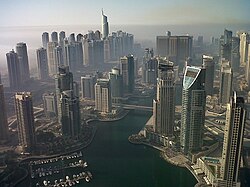
Dubai Marina is an artificial canal city, built along a 3-kilometre (2 mi) stretch of Persian Gulf shoreline. As of 2018[update], it had a population of 55,052.[215] When the entire development is complete, it will accommodate more than 120,000 people in residential towers and villas.[216] The 50 million square feet area of the Dubai Marina boasts a centrepiece that includes a 3.5-kilometer water canal which is the heart of the development and provides dual access to the sea, making Dubai Marina a foremost sailing destination.[217] It is on Interchange 5 between Jebel Ali Port and the area which hosts Dubai Internet City, Dubai Media City, and the American University in Dubai. The first phase of this project has been completed. Dubai Marina was inspired by the Concord Pacific Place development along False Creek in Vancouver, BC, Canada.[218] Much marine wildlife (especially whales and sharks) has entered the marina because of its proximity to the open sea.[219]
The structure consists of two towers connected at the bottom, with a sky bridge at the top that connects the 63rd through the 77th levels. The sky bridge houses luxury apartments on the world's highest occupiable floor at 294.36 metres.[citation needed] Known as Jumeirah Gate, it opened in December 2020 and is situated along the beach. The towers have the world's highest infinity pool in a building, on the roof, at a height of 293.906 metres.[220]
Transport in Dubai is controlled by the Roads and Transport Authority (RTA), an agency of the government of Dubai, formed by royal decree in 2005.[221] The public transport network has in the past faced congestion and reliability issues which a large investment programme has addressed, including over AED 70 billion of improvements planned for completion by 2020, when the population of the city is projected to exceed 3.5 million.[222] In 2009, according to Dubai Municipality statistics, there were an estimated 1,021,880 cars in Dubai.[223] In January 2010, the proportion of Dubai residents who use public transport stood at 6%.[224]


Five main routes – E 11 (Sheikh Zayed Road), E 311 (Sheikh Mohammed Bin Zayed Road), E 44 (Dubai-Hatta Highway), E 77 (Dubai-Al Habab Road), and E 66 (Oud Metha Road, Dubai-Al Ain Road, or Tahnoun Bin Mohammad Al Nahyan Road)[225] – run through Dubai, connecting the city to other towns and emirates. Additionally, several important intra-city routes, such as D 89 (Al Maktoum Road/Airport Road), D 85 (Baniyas Road), D 75 (Sheikh Rashid Road), D 73 (Al Dhiyafa Road now named as 2 December street), D 94 (Jumeirah Road), and D 92 (Al Khaleej/Al Wasl Road) connect the various localities in the city. The eastern and western sections of the city are connected by Al Maktoum Bridge, Al Garhoud Bridge, Al Shindagha Tunnel, Business Bay Crossing, and Floating Bridge.[226]
The RTA runs the public bus transport system in Dubai. The bus system services 140 routes and transports over 109 million people in 2008. By the end of 2010, there will be 2,100 buses in service across the city.[227] In 2006, the transport authority announced the construction of 500 air-conditioned passenger bus shelters, and planned for 1,000 more across the emirates in a move to encourage the use of public buses.[228]
The RTA licenses all taxi services. Dubai-licensed taxis are easily identifiable by their cream bodywork, with varied roof colours indicating the operator. Dubai Taxi Corporation, a division of the RTA, is the largest operator and operates red-roofed taxis. There are five private operators: Metro Taxis (orange roofs); Network Taxis (yellow roofs); Cars Taxis (blue roofs); Arabia Taxis (green roofs); and City Taxis (purple roofs). In addition, there is a Ladies and Families taxi service (pink roofs) with female drivers, which caters exclusively to women and children. More than 3,000 taxis operate in the emirate, making an average of 192,000 trips daily and carrying about 385,000 people. In 2009, taxi trips exceeded 70 million trips, serving around 140.45 million passengers.[229][230][231]

Dubai International Airport (IATA: DXB), the hub for the Emirates airline, serves the city of Dubai and other emirates in the country. The airport is the third-busiest airport in the world by passenger traffic and the world's busiest airport by international passenger traffic.[233] In addition to being an important passenger traffic hub, the airport is the sixth-busiest cargo airport in world, handling 2.37 million tons of cargo in 2014.[234] Emirates is one of the national flag carriers of the United Arab Emirates.[235] As of 2018[update], it operated internationally, serving over 150 destinations in over 70 countries across six continents.[236]
The development of Al Maktoum International Airport (IATA: DWC) was announced in 2004. The first phase of the airport, featuring one A380-capable runway, 64 remote stands, one cargo terminal with an annual capacity for 250,000 tonnes of cargo, and a passenger terminal building designed to accommodate five million passengers per year, has been opened.[237] When completed, Dubai World Central-Al Maktoum International will be the largest airport in the world with five runways, four terminal buildings, and capacity for 160 million passengers and 12 million tons of cargo.[238][239]


Dubai Metro consists of two lines (Red and Green) that run through the city's financial and residential areas. It was opened in September 2009.[242] UK-based international service company Serco is responsible for operating the metro. The Red Line is the major backbone, with 29 stations (4 underground, 24 elevated, and one at ground level) running from Rashidiya Station to UAE Xchange Station in Jebel Ali. The Green Line, running from the Etisalat Station to the Creek Station, has 20 stations (8 underground, 12 elevated). An extension to the Red Line connecting the EXPO 2020 site opened on 1 June 2021. A Blue and a Purple Line have also been planned. The Dubai Metro is the first urban train network in the Arabian Peninsula.[240] The trains are fully automated and driverless.[243]
A monorail line connecting the Palm Jumeirah to the mainland opened on 30 April 2009.[244] It is the first monorail in the Middle East.[245] An extension to connect to the Red Line of the Dubai Metro is planned.[246]
A tramway located in Al Sufouh runs for 14.5 km (9.0 mi) along Al Sufouh Road from Dubai Marina to the Burj Al Arab and the Mall of the Emirates with two interchanges with the Dubai Metro Red Line. The first section, a 10.6 km (6.6 mi)- long tram line serving 11 stations, was opened in 2014.[247]
Dubai has announced it will complete a link of the UAE high-speed rail system which is planned to link with the whole GCC (Gulf Cooperation Council, also known as Cooperation Council for the Arab States of the Gulf), and then possibly Europe.[citation needed] The high-speed rail will support passengers and cargo.[248]

There are two major commercial ports in Dubai, Port Rashid and Port Jebel Ali. Port Jebel Ali is the world's largest human-made harbour, the biggest port in the Middle East,[249] and the 7th-busiest port in the world.[140] One of the more traditional methods of getting across Bur Dubai to Deira is by abras, small boats that ferry passengers across the Dubai Creek, between abra stations in Bastakiya and Baniyas Road.[250] The Marine Transport Agency has also implemented the Dubai Water Bus System. The water bus is a fully air-conditioned boat service connecting selected destinations across the creek. One can also avail oneself of the tourist water bus facility in Dubai. The latest addition to the water transport system is the Water Taxi.[251] The Water-Taxis can transport a maximum of 20 passengers at a time which provides a smooth journey along Al Mamzar and Dubai Marina via Dubai Creek. It has 40 pickup points across Dubai.[252]
Dubai is increasingly leveraging its logistics and ports to participate in trade between Europe and China, as well as between Europe and Africa, in addition to oil transport. For this purpose, ports such as Jebel Ali and Mina Rashid are rapidly expanded, and investments are made in their technology. The country is historically and currently part of the Maritime Silk Road that runs from the Chinese coast to the south via the southern tip of India to Mombasa, from there through the Red Sea via the Suez Canal to the Mediterranean, there to the Upper Adriatic region to the northern Italian hub of Trieste with its rail connections to Central Europe, Eastern Europe, and the North Sea.[253][254][255]


The UAE's culture mainly reflects traditional Arab culture. The influence of Arab and Islamic culture on architecture, music, attire, cuisine, and lifestyle is also very prominent. Five times a day, Muslims are called to prayer from the minarets of mosques scattered across the country. Major holidays in Dubai include Eid al-Fitr, which marks the end of Ramadan, and National Day (2 December), which marks the formation of the United Arab Emirates.[256]
The city's cultural imprint as a small, ethnically homogeneous pearling community was transformed by the arrival of other ethnic groups and nationals—first by Iranians in the early 1900s, and later by Indians and Pakistanis in the 1960s. In 2005, 84% of the population of metropolitan Dubai was foreign-born, about half of them from India.[111]
From 2006 to 2022, the weekend had been Friday and Saturday, as a compromise between Friday's holiness to Muslims and the Western weekend of Saturday and Sunday.[257] Before 2006, the weekend was Thursday-Friday. On 1 January 2022, Dubai moved to a four-and-a-half-day working week, with the weekend comprising Friday afternoon, Saturday, and Sunday.[258]

Because of the touristic approach of many Dubai residents in the entrepreneurial sector and the high standard of living, Dubai's culture has gradually evolved towards one of luxury, opulence, and lavishness with a high regard for leisure-related extravagance.[259][260][261] Dubai is known for its nightlife. Clubs and bars are chiefly found in hotels due to liquor laws. The New York Times called Dubai "the kind of city where you might run into Michael Jordan at the Buddha Bar or stumble across Naomi Campbell celebrating her birthday with a multiday bash".[262]
Annual entertainment events such as the Dubai Shopping Festival[263] (DSF) and Dubai Summer Surprises (DSS) attract over 4 million visitors from across the region and generate revenues over $2.7 billion.[264][265] The International Festivals and Events Association (IFEA), the world's leading events trade association, has crowned Dubai as IFEA World Festival and Event City, 2012 in the cities category with a population of more than one million.[266][267]
Large shopping malls in the city, such as Deira City Centre, Mirdiff City Centre, BurJuman, Mall of the Emirates, Dubai Mall (the world's second-largest), Dubai Marina Mall, Dubai Hills Mall, Dragon Mart, Dubai Festival City Mall, and Ibn Battuta Mall as well as traditional Dubai Gold Souk, Al Souk Al Kabir (known as Meena Bazaar), and other souks attract shoppers from the region.[268]

Arabic cuisine is very popular and is available everywhere in the city, from the small shawarma diners in Deira and Al Karama to the restaurants in Dubai's hotels. Fast food, South Asian, and Chinese cuisines are also very popular and are widely available. The sale and consumption of pork is regulated and is legally permitted to be sold only to non-Muslims, in designated areas of supermarkets and airports.[269] Similarly, the sale of alcoholic beverages is also regulated. A liquor permit is required to purchase alcohol, but it is available at hotel bars and restaurants.[270] Shisha and qahwa boutiques are also popular in Dubai. Biryani is also a popular cuisine across Dubai.[271]
The inaugural Dubai Food Festival was held between 21 February and 15 March 2014.[272] According to Vision magazine, the event was aimed at enhancing and celebrating Dubai's position as the gastronomic capital of the region. The festival was designed to showcase the variety of flavours and cuisines on offer in Dubai, featuring dishes from over 200 nationalities.[273] The next food festival was held between 23 February 2017 and 11 March 2017.[274]

Dubai Opera opened its doors on 31 August 2016 in Downtown Dubai with a performance by Plácido Domingo. The venue is a 2000-seat, multifunctional performing arts centre that can host not only theatrical shows, concerts, and operas, but also weddings, gala dinners, banquets, and conferences. Arabic movies are popular in Dubai and the UAE. Since 2004, the city has hosted the annual Dubai International Film Festival which serves as a showcase for Arab and Middle Eastern filmmaking talent.[275] The Dubai Desert Rock Festival was also another major festival consisting of heavy metal and rock artists but is no longer held in Dubai.
One of the lesser-known sides of Dubai is the importance of its young contemporary art gallery scene. Since 2008, the leading contemporary art galleries such as Carbon 12 Dubai,[276] Green Art, gallery Isabelle van den Eynde, and The Third Line have brought the city onto the international art map. Art Dubai, the region's growing and reputable art fair, is also a major contributor to the development of the contemporary art scene.[277] The Theatre of Digital Art Dubai (ToDA) opened in 2020 and presents immersive digital art, including contemporary work.[278]

Many international news agencies, such as Reuters, APTN, Bloomberg L.P., and Middle East Broadcasting Centre (MBC), operate in Dubai Media City and Dubai Internet City. Additionally, several local network television channels, such as Dubai One (formerly Channel 33) and Dubai TV (EDTV), provide programming in English and Arabic, respectively. Dubai is also the headquarters for several print media outlets. Dar Al Khaleej, Al Bayan, and Al Ittihad are the city's largest circulating Arabic language newspapers,[279] while Gulf News, Khaleej Times, Khaleej Mag, and 7days are the largest circulating English newspapers.[280]
Etisalat, the government-owned telecommunications provider, held a virtual monopoly over telecommunication services in Dubai before the establishment of other, smaller telecommunications companies such as Emirates Integrated Telecommunications Company (EITC—better known as Du) in 2006. The Internet was introduced into the UAE (and therefore Dubai) in 1995. The network has an Internet bandwidth of 7.5 Gbit/s with a capacity of 49 STM1 links.[281] Dubai houses two of four Domain Name System (DNS) data centres in the country (DXBNIC1, DXBNIC2).[282] Censorship is common in Dubai and used by the government to control content that it believes violates the cultural and political sensitivities of Emirates.[283] Homosexuality, drugs, and the theory of evolution are generally considered taboo.[270][284]
Internet content is regulated in Dubai. Etisalat uses a proxy server to filter Internet content the government deems inconsistent with the values of the country, such as sites that provide information on how to bypass the proxy; sites about dating, gay and lesbian networks, and pornography; and formerly sites originating from Israel.[285] Emirates Media and Internet (a division of Etisalat) notes that as of 2002[update], 76% of Internet users are male. About 60% of Internet users were Asian, while 25% of users were Arab. Dubai enacted the Electronic Transactions and Commerce Law in 2002, which addresses digital signatures and electronic registers. It prohibits Internet Service Providers (ISPs) from disclosing information gathered in the course of providing services.[286] The penal code contains official provisions that prohibit digital access to pornography; however, it does not address cyber crime or data protection.[287] In 2019 the Italian artist Princess Bee produced "Hi Dubai", the first cross media format revealing the "soul of the city" through the life and work experience of 25 Emirati and expat women. The series also promoted the Emirate's lifestyle and main events to attract young people to visit and live in Dubai. "Hi Dubai" was on air on the national channel Dubai One TV in prime time, after the National News, during the U.A.E. National Day week; then distributed online on Dubai Post and in-flight on ICE across all Emirates Airlines flights.[288]

Football and cricket are the most popular sports in Dubai. The headquarters of the International Cricket Council is in Dubai. Three football teams (Al Wasl FC, Shabab Al-Ahli Dubai FC, and Al Nasr SC) represent Dubai in UAE Pro-League.[270] Al-Wasl have the second-most championships in the UAE League, after Al Ain. Dubai also hosts both the annual Dubai Tennis Championships and The Legends Rock Dubai tennis tournaments, as well as the Dubai Desert Classic golf tournament and the DP World Tour Championship, all of which attract sports stars from around the world. The Dubai World Cup, a thoroughbred horse race, is held annually at the Meydan Racecourse. The city's top basketball team has traditionally been Shabab Al Ahli Basket. Dubai also hosts the traditional rugby union tournament, Dubai Sevens, part of the Sevens World Series. Event pictures from Rugby 7 Dubai 2015. In 2009, Dubai hosted the 2009 Rugby World Cup Sevens. Auto racing is also a major sport in Dubai; the Dubai Autodrome hosts many auto racing events throughout the year. Another sporting event in Dubai is the Dubai Run, which is part of the Dubai Fitness Challenge and the world's largest free fun run, a main highlight of the challenge since 2017.[289] It also features a state-of-the-art indoor and outdoor Kartdrome, popular among racing enthusiasts and recreational riders. The Indian Premier League cricket competition was held in the UAE in 2020 due to the COVID-19 pandemic. On 12 June, Tommy Fleetwood, 7-time DP World Tour winner, was declared World Global Ambassador.[290] In 2025, Dubai introduced the "Dubai Sports Strategy 2033", a long-term framework designed to support the emirate’s sports sector and strengthen its position as a global sports destination. The strategy outlines initiatives to expand community participation in physical activity, enhance the quality and number of sporting events, and develop local talent across multiple disciplines. It also aims to increase the economic contribution of Dubai’s sports industry through targeted programmes and infrastructure development.[291]

The Emirati attire is typical of several countries in the Arabian Peninsula. Women usually wear the "abaya", a long black robe, with a hijab (a headscarf that covers the neck and part of the head, all of the hair and the ears). Some women may wear a niqab that covers the mouth and nose, leaving only the eyes exposed. Men wear the "kandurah" also referred to as "dishdasha" or even "thawb" (long white robe) and the headscarf (ghotrah). The traditional ghutrah in the UAE is white and held in place by an accessory called "egal", which resembles a black cord. Younger Emiratis prefer to wear red-and-white ghutrah and tie them around their heads like turbans.[292]
The dress code is never compulsory; many people wear Western or other Eastern clothing. However, prohibitions on "indecent clothing" or revealing too much skin are aspects of the UAE to which Dubai's visitors are expected to conform and are encoded in Dubai's criminal law.[293] The UAE has enforced decency regulations in most public places, aside from waterparks, beaches, clubs, and bars.[294]
The school system in Dubai follows the United Arab Emirates' system. As of 2009[update], there are 79 public schools run by the Ministry of Education that serve Emiratis and expatriate Arab people, as well as 207 private schools.[295] The medium of instruction in public schools is Arabic with emphasis on English as a second language, while most of the private schools use English as their medium of instruction. Currently, only the Swiss International Scientific School in Dubai claims to offer parallel streams in different languages – bilingual English/French or English/German.[296] Most private schools cater to one or more expatriate communities.[297]

Some 36 schools offer international education using one or more of the four International Baccalaureate Programmes for students aged 3–19.[298] Currently, 15 schools[299] have introduced the IB Career-related Programme that can be combined with a vocational qualification such as a BTEC.[300]
While there are more UK-curriculum-based schools in Dubai than any other curriculum, more students attend Indian-curriculum schools, which tend to be considerably larger and cost less to attend. There are 34 Indian-curriculum schools in the emirate,[301] most of which offer the CBSE, and just a handful the Indian Certificate of Secondary Education (ICSE) Indian syllabus. Examples of Indian-curriculum schools include IHS, DPS, and DMHS. There are a small number of Pakistani schools in Dubai offering the FBISE curriculum for expatriate children.
A total of 18 schools offer British primary education through age 11.[302] There are 64 schools that offer a variation of a UK curriculum style secondary education,[303] either a pure GCSE and A-Level offering, or increasingly I/GCSE up to 16, and then the IB Diploma post-16. Currently, no school in the UAE offers IB or A-Level at 16, but several schools have said they will offer them in the future. British style eleven-to-eighteen secondary schools offering General Certificate of Secondary Education and A-Levels include Dubai College, Dubai British School, and English Language School Pvt. Some schools, such as The American School of Dubai, also offer the curriculum of the United States.[304]
Dubai has a very active education regulator, the KHDA, which is best known for its school ratings, but actually has a wide mandate[305] when it comes to school improvement in the emirate. Its inspections truly matter, and there is no doubt that school quality has improved as a result of its implementation. A total of 17 schools are currently rated Outstanding (2020), and a further 40 are rated Very Good. Parents in general rate schools highly.[306]
The top 10 largest universities by student numbers in Dubai according to the KHDA (2024)[307] are Middlesex University Dubai, Heriot-Watt University Dubai, University of Wollongong in Dubai, Manipal Academy of Higher Education, Dubai, American University in Dubai, S P Jain School of Global Management, Rochester Institute of Technology of Dubai, Amity University Dubai, University of Birmingham Dubai, and Birla Institute of Technology and Science Pilani Dubai. They offer courses in all major subjects, with the most popular subject areas being Business, followed by Information Technology, then Engineering.[307] Most Universities in Dubai are located in the two Educational Zones (Knowledge Village or Academic City). In 2013, Synergy University Dubai Campus[308] opened its campus in Jumeirah Lakes Towers being a first University in Dubai to be located outside of Educational Zones (Knowledge Village or Academic City).[309]
Only 4 Dubai Universities are present in the QS World University Rankings 2024/2025.[310] To allow the assessment of more UAE Universities, the Ministry of Education launched The National Higher Education Institutions Classification Framework[311] which classifies UAE Universities based on their research and teaching. Of the top 10 largest Dubai universities University of Wollongong in Dubai, American University in Dubai, and Rochester Institute of Technology of Dubai, were all classified as "Very Good" within The National Higher Education Institutions Classification Framework.[311]

Healthcare in Dubai can be divided into two different sectors: public and private. Each Emirate can set healthcare standards in accordance with its internal laws, though the standards and regulations rarely differ significantly. Public hospitals in Dubai were first built in the late 1950s and continued to grow with public health initiatives. There are now 28 hospitals in Dubai, six public and 22 private, with three more major hospitals scheduled to be built by 2025.[312]
By the end of 2012, there were also a total of 1,348 medical clinics, 97% of which were operated privately.[313] In 2015, Dubai phased in mandatory health insurance for all inhabitants, thereby leading to increased demand for medical services.[314]
Dubai Hospital is a public hospital in Dubai and is part of Dubai Department of Health and Medical Services. Although the decision to construct Dubai Hospital was made in 1977, it did not begin admitting patients until March 1983.[315] The hospital consists of 14 stories, with the lower two for Accident & Emergency and outpatients, and the upper ten forwards.
Dubai is twinned with:[316]
 Amman, Jordan
 Beirut, Lebanon
 Busan, South Korea (2006)
 Cape Town, South Africa
 Casablanca, Morocco
 Kish Island, Iran
 Damascus, Syria Dundee, Scotland, UK (2004)[317] Detroit, USA (2003) Frankfurt, Germany (2005)
 Gaza City, Palestine[318]
 Gold Coast, Australia (2001)
 Guangzhou, China[319]
 Istanbul, Turkey (1997)
 Kuala Lumpur, Malaysia (2010)[320]
 Moscow, Russia[321]
 Mumbai, India
 Osaka Prefecture, Japan (2002)
 Pyongyang, North Korea[322]
 San Juan, Puerto Rico
 San Salvador, El Salvador Shanghai, China
cite news: CS1 maint: multiple names: authors list (link)Extreme rains brought to a halt one of the hottest and driest cities on Earth.
cite web: CS1 maint: multiple names: authors list (link)cite book: CS1 maint: location missing publisher (link)cite book: CS1 maint: others (link)cite news: CS1 maint: multiple names: authors list (link)More than 56% of Dubai residents are Muslims, 25% of the population is Christian and 16% is Hindu. 2% of Dubai's population follows a religion other than Islam.
 Media from Commons
 News from Wikinews
 Travel information from Wikivoyage
 Data from Wikidata
|
Places adjacent to Dubai
|
||||||||||||||||
|---|---|---|---|---|---|---|---|---|---|---|---|---|---|---|---|---|
|
||||||||||||||||
|
|||||||||||||||||
|
|||||||||||||||||
|
|||||||||||||||||
|
|||||||||||||||||
|
|||||||||||||||||
|
|||||||||||||||||
|
|
|
| Rulers |
|
|---|---|
 Category:Rulers of Dubai Category:Rulers of Dubai |
|
Major cities of the United Arab Emirates| Abu Dhabi |
|
|---|---|
| Dubai |
|
| Sharjah |
|
| Ajman |
|
| Umm Al Quwain |
|
| Ras Al Khaimah |
|
| Fujairah |
|
|
Authority control databases
|
|
|---|---|
| International |
|
| National |
|
| Geographic |
|
| Other |
|
 |
|
| Race details | |
|---|---|
| Date | October (2015 and 2016) February (2017) |
| Region | Abu Dhabi |
| Discipline | Road |
| Competition | UCI Asia Tour |
| Type | Stage race |
| Organiser | RCS Sport |
| Web site | www |
| History | |
| First edition | 2015 |
| Editions | 4 |
| Final edition | 2018 |
| First winner |  Esteban Chaves (COL) Esteban Chaves (COL) |
| Most wins | No repeat winners |
| Final winner |  Alejandro Valverde (ESP) Alejandro Valverde (ESP) |
The Abu Dhabi Tour was a men's cycling stage race that took place in the United Arab Emirates, held annually between 2015 and 2018. In 2019, the Abu Dhabi Tour merged with the Dubai Tour to become the UAE Tour.[1]
When inaugurated, it was part of the UCI Asia Tour, ranked as a category 2.HC event, the second tier of professional stage races.[2] The race was initially scheduled for October, as one of the last races of the cycling season, occupying the calendar slot formerly held by the cancelled Tour of Beijing. The event is organised by RCS Sport, which also organises the Giro d'Italia and the nearby Dubai Tour.[3]
In 2015 UCI organized the first International Cycling Gala on the evening of the final day of the Abu Dhabi Tour, to celebrate the end of the cycling season. The event's organizers expressed their hope that the race be included in the UCI World Tour.[4] In 2016 the Abu Dhabi Tour started two days after the Cycling Gala in the week following the Road World Championships in Qatar.[5]
The third edition of the Abu Dhabi Tour was added to the 2017 UCI World Tour and scheduled to be held at the beginning of the season, in February 2017.[6][7]
In 2019, the Abu Dhabi Tour was merged with the Dubai Tour to become the UAE Tour.[8]
The first two editions of the race were made up of four stages; three of which flat and suited to the sprinters and one mountain-top finish at Jebel Hafeet. The final stage is a circuit race around the Yas Marina motor-racing track which take place at twilight, as does the Abu Dhabi Grand Prix.
| Year | Country | Rider | Team |
|---|---|---|---|
| 2015 | Colombia |
Esteban Chaves | Orica–GreenEDGE |
| 2016 |  Estonia Estonia |
Tanel Kangert | Astana |
| 2017 |  Portugal Portugal |
Rui Costa | UAE Team Emirates |
| 2018 | Spain |
Alejandro Valverde | Movistar Team |
| Agency overview | |
|---|---|
| Formed | 30 November 2005 |
| Jurisdiction | Government of Dubai |
| Headquarters | Dubai Design District Dubai (Building Number 6, 5th Floor) P.O. Box 9888 |
| Agency executives |
|
| Website | www |
Dubai Sports Council is the official sports governing body of the Government of Dubai. It is the lead entity tasked with developing a holistic sports culture for the Emirate.[1] It was founded in 30 November 2005.
Mansoor bin Mohammed Al Maktoum is the first Chairman of the Dubai Sports Council.[2]
cite web: Missing or empty |title= (help) |
Winner | Elia Viviani (ITA) |
(Quick-Step Floors) |
|---|---|---|---|
| Second |  Magnus Cort Nielsen (DEN) Magnus Cort Nielsen (DEN) |
(Astana) | |
| Third | Sonny Colbrelli (ITA) |
(Bahrain–Merida) | |
|
|
|||
 |
Points | Elia Viviani (ITA) |
(Quick-Step Floors) |
 |
Youth | Magnus Cort Nielsen (DEN) |
(Astana) |
| Sprints |  Quentin Valognes (FRA) Quentin Valognes (FRA) |
(Team Novo Nordisk) | |
| Team | BMC Racing Team | ||
| 2018 UCI Asia Tour | |
|---|---|
| Race details | |
| Dates | 6–10 February 2018 |
| Stages | 5 |
| Distance | 841[1] km (522.6 mi) |
| Winning time | 19h 05' 46" |
| Results | |
The 2018 Dubai Tour was a road cycling stage race that took place in Dubai between 6 and 10 February 2018. It was the fifth edition of the Dubai Tour and was rated as a 2.HC event as part of the 2018 UCI Asia Tour.[2]
| Stage | Date | Course | Distance | Type | Stage winner | |
|---|---|---|---|---|---|---|
| 1 | 6 February | Dubai to Palm Jumeirah | 167 km (104 mi) |  |
Flat stage |  Dylan Groenewegen (NED) Dylan Groenewegen (NED) |
| 2 | 7 February | Dubai to Ras Al Khaimah | 190 km (120 mi) | |
Flat stage | Elia Viviani (ITA) |
| 3 | 8 February | Dubai to Fujairah City | 180 km (110 mi) | |
Flat stage | Mark Cavendish (GBR) |
| 4 | 9 February | Dubai to Hatta | 172 km (107 mi) |  |
Hilly stage | Sonny Colbrelli (ITA) |
| 5 | 10 February | Dubai to Dubai | 132 km (82 mi) | |
Flat stage | Elia Viviani (ITA) |
Stage 1 result[3][5]
|
General classification after Stage 1[3][5]
|
Stage 2 result[3][6]
|
General classification after Stage 2[3][6]
|
Race leader Dylan Groenewegen received a 20-second penalty for sheltering too long behind a team car.
Stage 3 result[3][7]
|
General classification after Stage 3[3][7]
|
Stage 4 result[3][8]
|
General classification after Stage 4[3][8]
|
Stage 5 result[3][9]
|
In the 2018 Dubai Tour, four different jerseys were awarded. For the general classification, calculated by adding each cyclist's finishing times on each stage, and allowing time bonuses for the first three finishers at intermediate sprints and at the finish of mass-start stages, the leader received a blue jersey. This classification was considered the most important of the 2018 Dubai Tour, and the winner of the classification was considered the winner of the race.
Additionally, there was a points classification, which awarded a red jersey. In the points classification, cyclists received points for finishing in the top 10 in a stage. For winning a stage, a rider earned 25 points, with 16 for second, 11 for third, 8 for fourth, 6 for fifth with a point fewer per place down to a single point for 10th place. Points towards the classification could also be accrued at intermediate sprint points during each stage; these intermediate sprints also offered bonus seconds towards the general classification. There was also a sprints classification for the points awarded at the aforementioned intermediate sprints, where the leadership of which was marked by a jersey in the colours of the United Arab Emirates flag.
The fourth jersey represented the young rider classification, marked by a white jersey. This was decided in the same way as the general classification, but only riders born after 1 January 1993 were eligible to be ranked in the classification.
| Stage | Winner | General classification |
Points classification |
Intermediate sprints classification |
Youth classification |
|---|---|---|---|---|---|
| 1 | Dylan Groenewegen | Dylan Groenewegen | Dylan Groenewegen | Daniel Teklehaimanot | Dylan Groenewegen |
| 2 | Elia Viviani | Nathan Van Hooydonck | |||
| 3 | Mark Cavendish | Elia Viviani | Nathan Van Hooydonck | ||
| 4 | Sonny Colbrelli | Elia Viviani | Magnus Cort Nielsen | ||
| 5 | Elia Viviani | Quentin Valognes | |||
| Final | Elia Viviani | Elia Viviani | Quentin Valognes | Magnus Cort Nielsen | |
Final general classification[9]
|
Final points classification[9]
|
Final young rider classification[9]
|
|
Winner | Marcel Kittel (Germany) |
(Quick-Step Floors) |
|---|---|---|---|
| Second | Dylan Groenewegen (Netherlands) |
(LottoNL–Jumbo) | |
| Third | John Degenkolb (Germany) |
(Trek–Segafredo) | |
|
|
|||
|
Points | Marcel Kittel (Germany) |
(Quick-Step Floors) |
|
Youth | Dylan Groenewegen (Netherlands) |
(LottoNL–Jumbo) |
| Sprints | Nicola Boem (Italy) |
(Bardiani–CSF) | |
| Team | UAE Abu Dhabi | ||
| UCI Asia Tour | |
|---|---|
| Race details | |
| Dates | 31 January – 4 February 2017 |
| Stages | 4[a] |
| Distance | 691 km (429.4 mi) |
| Winning time | 15h 08' 56" |
| Results | |
The 2017 Dubai Tour was a road cycling stage race that took place in Dubai between 31 January and 4 February 2017. It was the fourth edition of the Dubai Tour and was rated as a 2.HC event as part of the 2017 UCI Asia Tour.[2]
The race was won for the second consecutive year by Germany's Marcel Kittel for the Quick-Step Floors team.[3][4] Kittel won three of the four stages to be run – comfortably winning the points classification as a result – while in the other stage, Kittel was involved in a skirmish with Andriy Hrivko, which resulted in the Astana rider being ejected from the race.[5][6] Kittel won the overall classification by 18 seconds ahead of LottoNL–Jumbo's Dylan Groenewegen from the Netherlands, who won the young rider classification in doing so. The final podium was completed by Kittel's compatriot John Degenkolb,[3] a further two seconds in arrears, with the Trek–Segafredo rider winning the stage not won by Kittel. In the other race classifications, Italian rider Nicola Boem (Bardiani–CSF) won the intermediate sprints classification, while the UAE Abu Dhabi squad won the teams classification.[3]
As the Dubai Tour was a 2.HC event, a limited number of UCI WorldTeams were able to participate in the race. In total, 16 teams participated in the race: 10 UCI WorldTeams, 4 Professional Continental teams, Continental team ONE Pro Cycling, and a national selection from the United Arab Emirates.[7]
UCI WorldTeams
UCI Professional Continental Teams
UCI Continental Teams
National teams
For the 2017 Dubai Tour, the race was extended from four stages to five stages.[8] The full itinerary was released on 13 December 2016.[9]
The fourth stage, initially scheduled to be run over 172 km (107 mi) and to start in Dubai was initially shortened due to strong winds and sandstorms. The new stage was 109 km (68 mi) long and due to start in Hatta, whilst still finishing at the Hatta Dam.[10] The stage was later cancelled altogether due to the winds.[11]
| Stage | Date | Route | Distance | Type | Winner | |
|---|---|---|---|---|---|---|
| 1 | 31 January | Dubai to Palm Jumeirah | 181 km (112 mi) |  |
Flat stage | Marcel Kittel (GER) |
| 2 | 1 February | Dubai to Ras al-Khaimah | 186 km (116 mi) | |
Flat stage | Marcel Kittel (GER) |
| 3 | 2 February | Dubai to Al Aqah | 200 km (124 mi) | |
Flat stage | John Degenkolb (GER) |
| 4 | 3 February | Hatta to Hatta Dam | 109 km (68 mi)[b] |  |
Medium-mountain stage | Stage cancelled[a] |
| 5 | 4 February | Dubai to City Walk | 124 km (77 mi) | |
Flat stage | Marcel Kittel (GER) |
|
|
|
|
|
|
The stage was cancelled altogether due to strong winds.[11]
| Rank | Rider | Team | Time |
|---|---|---|---|
| 1 | Marcel Kittel (GER) |
Quick-Step Floors | 12h 34' 54" |
| 2 | Dylan Groenewegen (NED) |
LottoNL–Jumbo | + 8" |
| 3 | John Degenkolb (GER) |
Trek–Segafredo | + 10" |
| 4 | Nicola Boem (ITA)  |
Bardiani–CSF | + 13" |
| 5 |  Jempy Drucker (LUX) Jempy Drucker (LUX) |
BMC Racing Team | + 14" |
| 6 | Reinardt Janse van Rensburg (RSA) |
Team Dimension Data | + 14" |
| 7 | Alex Dowsett (GBR) |
Movistar Team | + 14" |
| 8 | Tom Stewart (GBR) |
ONE Pro Cycling | + 14" |
| 9 | Jakub Mareczko (ITA) |
Wilier Triestina–Selle Italia | + 16" |
| 10 | Mark Cavendish (GBR) |
Team Dimension Data | + 16" |
|
|
In the 2017 Dubai Tour, four different jerseys were awarded. For the general classification, calculated by adding each cyclist's finishing times on each stage, and allowing time bonuses for the first three finishers at intermediate sprints and at the finish of mass-start stages, the leader received a blue jersey. This classification was considered the most important of the 2017 Dubai Tour, and the winner of the classification was considered the winner of the race.
Additionally, there was a points classification, which awarded a red jersey. In the points classification, cyclists received points for finishing in the top 10 in a stage. For winning a stage, a rider earned 25 points, with 16 for second, 11 for third, 8 for fourth, 6 for fifth with a point fewer per place down to a single point for 10th place. Points towards the classification could also be accrued at intermediate sprint points during each stage; these intermediate sprints also offered bonus seconds towards the general classification. There was also a sprints classification for the points awarded at the aforementioned intermediate sprints, where the leadership of which was marked by a jersey in the colours of the United Arab Emirates flag.
The fourth jersey represented the young rider classification, marked by a white jersey. This was decided in the same way as the general classification, but only riders born after 1 January 1992 were eligible to be ranked in the classification. There was also a classification for teams, in which the times of the best three cyclists per team on each stage were added together; the leading team at the end of the race was the team with the lowest total time.
| Stage | Winner | General classification |
Points classification |
Young rider classification |
Sprints classification |
Team classification |
|---|---|---|---|---|---|---|
| 1[20] | Marcel Kittel | Marcel Kittel | Marcel Kittel | Dylan Groenewegen | Nicola Boem | UAE Abu Dhabi |
| 2[21] | Marcel Kittel | |||||
| 3[22] | John Degenkolb | |||||
| 4[1] | Stage cancelled | |||||
| 5[3] | Marcel Kittel | |||||
| Final[3] | Marcel Kittel | Marcel Kittel | Dylan Groenewegen | Nicola Boem | UAE Abu Dhabi | |
| Tournament information | |
|---|---|
| Location | Dubai, United Arab Emirates |
| Established | 2024 |
| Course | Dubai Creek Golf & Yacht Club |
| Par | 71 |
| Length | 7,059 yards (6,455 m) |
| Tour | European Tour |
| Format | Stroke play |
| Prize fund | US$2,500,000 |
| Month played | January |
| Tournament record score | |
| Aggregate | 265 Tommy Fleetwood (2024) |
| To par | −19 as above |
| Current champion | |
 Tommy Fleetwood Tommy Fleetwood |
|
| Location map | |

 Dubai Creek Resort
Location in the United Arab Emirates
|
|
The Dubai Invitational is a professional golf tournament played on the European Tour.
The tournament was revealed as part of the 2024 European Tour schedule announcement in August 2023.[1][2] The invitational tournament is a limited-field pro-am with 60 professionals playing alongside 60 amateurs in the first three rounds, with the final round taking place between the professionals only.[3] The tournament is played biannually.[4][5]
Tommy Fleetwood won the inaugural edition, birdieing the final hole to beat Thriston Lawrence and Rory McIlroy by one shot.[6] The inaugural event also gained attraction and scrutiny due to American club professional Ken Weyand being given a sponsor's invite to play in the event. He only managed to make two birdies during the week, finishing at 53-over-par; 72 shots behind the winning score.[7]
| Year | Winner | Score | To par | Margin of victory |
Runners-up |
|---|---|---|---|---|---|
| 2024 | Tommy Fleetwood |
265 | −19 | 1 stroke | Thriston Lawrence Rory McIlroy Rory McIlroy |
25°14′35″N 55°20′02″E / 25.243°N 55.334°E
 |
|
| Race details | |
|---|---|
| Date | February |
| Region | United Arab Emirates |
| Discipline | Road |
| Competition | UCI World Tour |
| Type | Stage race |
| Organiser | RCS Sport |
| Web site | theuaetour |
| History (men) | |
| First edition | 2019 |
| Editions | 7 (as of 2025) |
| First winner |  Primož Roglič (SLO) Primož Roglič (SLO) |
| Most wins | Tadej Pogačar (SLO) (3 wins) |
| Most recent | Tadej Pogačar (SLO) |
| History (women) | |
| First edition | 2023 |
| Editions | 3 (as of 2025) |
| First winner | Elisa Longo Borghini (ITA) |
| Most wins | Elisa Longo Borghini (ITA) (2 wins) |
| Most recent | Elisa Longo Borghini (ITA) |
The UAE Tour (Arabic: جولة الإمارات) are road cycling stage races in the United Arab Emirates. A men's event was first held in 2019 as part of the UCI World Tour. It was created as a result of the merging of the Abu Dhabi Tour and the Dubai Tour. A women's event was first held in 2023 as part of the UCI Women's World Tour. The race is owned by the Abu Dhabi Sports Council and organised by RCS Sport, the organisers of the Giro d'Italia and Giro d'Italia Women.[1]
The Dubai Tour was first held in 2014, with the Abu Dhabi Tour first held in 2015. The Abu Dhabi Tour joined the UCI World Tour calendar in 2017.[2] In September 2018, the organisers of both races announced their intent to merge, resulting in the UAE Tour, a longer race that would use stages from both events.[2]
The first edition of the race took place between 24 February and 2 March 2019 as part of the 2019 UCI World Tour.[3] The 2020 UAE Tour was affected by the COVID-19 pandemic, with the last two stages cancelled and teams quarantined before being able to leave the country.[4]
In January 2023, organisers announced that a women's race would be held for the first time, as part of the UCI Women's World Tour.[5] This was first staged over 4 days in early February 2023, prior to the men's race.[6] Owing to crosswinds, stage 2 of the 2025 edition had an average speed of 48.407 kilometres per hour (30.079 mph), making it the fastest ever UCI Women's World Tour stage.[7]
Both races use similar stages to that of the Abu Dhabi Tour and Dubai Tour – a combination of flat sprint stages and mountain stages using climbs such as Jebel Jais and Jebel Hafeet.[8][9] Stages in the open desert can be affected by crosswinds.[7][8] In the men's race, a time trial is also usually part of the route, with the 2019 and 2023 editions featuring a team time trial.[8]
The Jebel Jais climb is usually considered the queen stage of the race, with 20 kilometres (12 mi) of climbing at 5%, with some 7% in the last 2 kilometres (1.2 mi).[10][11]
| Years | General classification |
Points classification |
Sprints classification |
Young rider classification |
|---|---|---|---|---|
| 2019 | Primož Roglič (Team Jumbo–Visma) |
Elia Viviani (Deceuninck–Quick-Step) |
not awarded | David Gaudu (Groupama–FDJ) |
| 2020 | Adam Yates (Mitchelton–Scott) |
Caleb Ewan (Lotto–Soudal) |
 Veljko Stojnić (Vini Zabù–KTM) Veljko Stojnić (Vini Zabù–KTM) |
Tadej Pogačar (UAE Team Emirates) |
| 2021[12] | Tadej Pogačar (UAE Team Emirates) |
David Dekker (Team Jumbo–Visma) |
Tony Gallopin (AG2R Citroën Team) |
Tadej Pogačar (UAE Team Emirates) |
| 2022[13] | Tadej Pogačar (UAE Team Emirates) |
 Jasper Philipsen (Alpecin–Fenix) Jasper Philipsen (Alpecin–Fenix) |
Dmitry Strakhov (Gazprom–RusVelo) |
Tadej Pogačar (UAE Team Emirates) |
| 2023[14] | Remco Evenepoel (Soudal–Quick-Step) |
Tim Merlier (Soudal–Quick-Step) |
Edward Planckaert (Alpecin–Deceuninck) |
Remco Evenepoel (Soudal–Quick-Step) |
| 2024[15] | Lennert Van Eetvelt (Lotto–Dstny) |
Tim Merlier (Soudal–Quick-Step) |
Mark Stewart (Team Corratec–Vini Fantini) |
Lennert Van Eetvelt (Lotto–Dstny) |
| 2025[16] | Tadej Pogačar (UAE Team Emirates XRG) |
Jonathan Milan (Lidl–Trek) |
Đorđe Đurić (Team Solution Tech–Vini Fantini) |
Iván Romeo (Movistar Team) |
| Wins | Country |
|---|---|
| 4 | Slovenia |
| 2 | Belgium |
| 1 | Great Britain |
| Years | General classification |
Points classification |
Sprints classification |
Young rider classification |
|---|---|---|---|---|
| 2023[17] | Elisa Longo Borghini (Trek–Segafredo) |
Charlotte Kool (Team DSM) |
 Agnieszka Skalniak-Sójka (Canyon–SRAM) Agnieszka Skalniak-Sójka (Canyon–SRAM) |
Gaia Realini (Trek–Segafredo) |
| 2024[18] | Lotte Kopecky (Team SD Worx–Protime) |
Lorena Wiebes (Team SD Worx–Protime) |
Lotte Kopecky (Team SD Worx–Protime) |
Neve Bradbury (Canyon–SRAM) |
| 2025[19] | Elisa Longo Borghini (UAE Team ADQ) |
Lorena Wiebes (Team SD Worx–Protime) |
 Lara Gillespie (UAE Team ADQ) Lara Gillespie (UAE Team ADQ) |
Antonia Niedermaier (Canyon–SRAM Zondacrypto) |
| Wins | Country |
|---|---|
| 2 | Italy |
| 1 | Belgium |
run by Giro d'Italia organisers RCS Sport on behalf of the Abu Dhabi Sports Council

The Abu Dhabi Junior Golf Championship (ADJGC), in association with The Telegraph, is an international golf tournament for players under the age of 18 years.
The tournament has its origins in the 1960s, when it was organised by The Daily Telegraph. In the early days it was an informally organised competition that took place during the school holidays. Today it attracts a considerable field of junior golfers from Great Britain and Ireland and offers boys and girls the opportunity to experience a major tournament and ultimately bid to become the Junior Golf Champion. In recent years[which?] around 40,000 juniors have taken part in the qualifying round.
It is open to all permanent British and Irish residents under the age of 18 at the start of the year. A handicap of 28 and below for boys and 36 and below for girls is required.[citation needed]
The finals of the Abu Dhabi Junior Golf Championship, in association with The Telegraph, will feature 10 boys who qualify via the leaderboard, one boy who will receive a sponsor’s invite, the girls' defending champion Hayley Davis, seven girls who qualify via the leaderboard and one girl who will receive a sponsor’s invite . The winner of the Abu Dhabi Golf Club Junior Open, which took place the month before, will also complete the 21-strong field.
Before the finals begin, a challenge match will take place, in which 21 of the UAE and Middle East’s best young players will compete with the visitors.[1]
Success in the tournament has acted as a springboard for some exceptional young golfers, with past winners including Justin Rose and Andrew Coltart, who have gone on to play at the highest level. Current boys and girls champions Stiggy Hodgson and Carly Booth[2] have both represented Great Britain and Ireland in amateur tournaments.[3]
Other past champions of note include Mhairi McKay, Rebecca Hudson and Oliver Fisher.
Boys
Girls
Abu Dhabi Tourism Authority have Title Sponsored the event since 2009 Abu Dhabi Tourism Authority (ADTA).
The involvement of ADTA, which manages and develops the emirate’s tourism industry, is part of its strategy to market Abu Dhabi as a premier golfing destination.
Abu Dhabi is home to the annual Abu Dhabi Golf Championship, a European Tour event that, along with the Qatar Masters and the Dubai Desert Classic, forms part of the early-season Gulf Swing of January and February each year.
Like the ADJGC, the Abu Dhabi Golf Championship is held at the Abu Dhabi Golf Club.

Chris Lloyd completed a thrilling finish to the tournament by overhauling long-time leader Tom Lewis to take the boys title. In the girls match, Alexandra Peters held on to her overnight lead on the final day to take the trophy.
Lloyd played a winning final round of 73 to beat Lewis, who had led by eight shots at the end of the first round and four shots going into the final day's play. Lloyd, 17, from Bristol, bore down on Lewis and took the lead on the 12th hole. With a one shot lead going into the final hole he held his nerve to win with a final score of 11 under. Tomasz Anderson took third place with a score of four over.

Peters clinched the girls’ championship with a final score of five under, leaving her well ahead of nearest rival Jessica Wilcox who ended the tournament on level par. The 16-year-old, from Shifnal, Nottinghamshire, had gone into the final day with a four-shot lead and never looked in danger of losing it.
Finishing strongly, Wilcox jumped into second place helped by a run of three birdies on the front nine, ahead of Holly Clyburn and Heidi Baek who both recorded scores of three over.
Stiggy Hodgson holed a 15-ft birdie putt on the second playoff hole to beat Tommy Fleetwood and win the 2008 Abu Dhabi Junior Golf Championship boys title. The two leaders finished 12 shots ahead of the field by finishing 12 under par over the three rounds.
Hodgson, who plays with an unorthodox swing with its exaggerated head turn, did not drop a shot until the last hole, a poor bunker recovery and three-putt against Fleetwood's seventh birdie, cancelling out a seemingly decisive two-stroke lead to take the final into sudden death.
Carly Booth, meanwhile, was untroubled by any of the competing girls as she decisively took the title. Her win by six shots at four under illustrated her mastery of the Abu Dhabi Golf Club’s National course.
|
Winner | Marcel Kittel (GER) |
(Etixx–Quick-Step) |
|---|---|---|---|
| Second | Giacomo Nizzolo (ITA) |
(Trek–Segafredo) | |
| Third | Juan José Lobato (ESP) |
(Movistar Team) | |
|
|
|||
|
Points | Marcel Kittel (GER) |
(Etixx–Quick-Step) |
|
Youth | Soufiane Haddi (MAR) |
(Skydive Dubai–Al Ahli) |
 |
Sprints | Marcin Białobłocki (POL) |
(ONE Pro Cycling) |
| UCI Asia Tour | |
|---|---|
| Race details | |
| Dates | 3–6 February 2016 |
| Stages | 4 |
| Distance | 671 km (416.9 mi) |
| Winning time | 14h 46' 54" |
| Results | |
The 2016 Dubai Tour was a road cycling stage race that took place in Dubai between 3 and 6 February 2016. It was the third edition of the Dubai Tour and was rated as a 2.HC event as part of the 2016 UCI Asia Tour.[1]
The race was made up of four stages. Three of these were suited for sprinters, with the third stage ending with an uphill finish to the Hatta Dam. The defending champion was Mark Cavendish, who won the 2015 Dubai Tour for Etixx–Quick-Step but was riding for his new team, Team Dimension Data.[1]
Marcel Kittel (Etixx–Quick-Step) won the first stage to take the lead of the race. Elia Viviani (Team Sky) won the second stage and took over the race lead. The Hatta Dam stage was won by Juan José Lobato (Movistar Team), with Giacomo Nizzolo (Trek–Segafredo taking the overall lead of the race. Kittel won the final stage and, with the help of bonus seconds, took the overall victory. Nizzolo was second, with Lobato third.
Sixteen teams were invited to take part in the race. Ten of these were UCI WorldTeams; there were also three UCI Professional Continental teams and three UCI Continental teams. There were a maximum of eight riders per team; since not every team brought their full quota of riders, 123 riders were entered in the startlist.[2]
UCI WorldTeams
UCI Professional Continental teams
UCI Continental teams
| Stage | Date | Route | Distance | Type | Winner | |
|---|---|---|---|---|---|---|
| 1 | 3 February | Dubai–Fujairah | 179 km (111 mi) | |
Flat stage | Marcel Kittel (GER) |
| 2 | 4 February | Dubai–Palm Jumeirah | 188 km (117 mi) | |
Flat stage | Elia Viviani (ITA) |
| 3 | 5 February | Dubai–Hatta Dam | 172 km (107 mi) |  |
Hilly stage | Juan Jose Lobato (SPA) |
| 4 | 6 February | Dubai–Burj Khalifa | 132 km (82 mi) | |
Flat stage | Marcel Kittel (GER) |
3 February 2016 – Dubai–Fujairah, 179 km (111 mi)
|
|
4 February – Dubai–Palm Jumeirah (188 km (117 mi))
|
|
5 February – Dubai–Hatta Dam, 172 km (107 mi)
|
|
6 February – Dubai–Burj Khalifa, 132 km (82 mi)
|
|
| Stage | Winner | General classification |
Points classification |
Sprint classification |
Young rider classification |
|---|---|---|---|---|---|
| 1 | Marcel Kittel | Marcel Kittel | Marcel Kittel | Soufiane Haddi | Soufiane Haddi |
| 2 | Elia Viviani | Elia Viviani | Elia Viviani | Marcin Białobłocki | |
| 3 | Juan José Lobato | Giacomo Nizzolo | Giacomo Nizzolo | ||
| 4 | Marcel Kittel | Marcel Kittel | Marcel Kittel | ||
| Final | Marcel Kittel | Marcel Kittel | Marcin Białobłocki | Soufiane Haddi | |
| Tournament information | |
|---|---|
| Venue | Riverside Montien Hotel |
| Location | Bangkok |
| Country | Thailand |
| Established | 1988 |
| Organisation(s) | World Professional Billiards and Snooker Association |
| Format | Ranking event |
| Final year | 1996 |
| Final champion | Ronnie O'Sullivan |
The Dubai Classic (also known as the Dubai Duty Free Classic for sponsorship and marketing purposes) was a professional ranking snooker tournament. The last champion was Ronnie O'Sullivan.
It began life as the Dubai Masters in 1988, the first major tournament in the Middle East. The following year it was renamed to Dubai Classic, and it became the first ranking event in the Middle East. During its tenure in Dubai, the tournament was played at the multi-purpose stadium of the Al-Nasr Sports Club.[1]
Later the event was moved to Thailand and renamed to Thailand Classic for 1995/96 and Asian Classic for 1996/97, before being dropped from the calendar.[2][3]
| Year | Winner | Runner-up | Final score | Season |
|---|---|---|---|---|
| Dubai Masters (non-ranking)[1] | ||||
| 1988 | Neal Foulds |
Steve Davis |
5–4 | 1988/89 |
| Dubai Classic (ranking)[1][4] | ||||
| 1989 |  Stephen Hendry Stephen Hendry |
 Doug Mountjoy Doug Mountjoy |
9–2 | 1989/90 |
| 1990 | Stephen Hendry |
Steve Davis |
9–1 | 1990/91 |
| 1991 | John Parrott |
Tony Knowles |
9–3 | 1991/92 |
| 1992 | John Parrott |
Stephen Hendry |
9–8 | 1992/93 |
| 1993 | Stephen Hendry |
Steve Davis |
9–3 | 1993/94 |
| 1994 | Alan McManus |
Peter Ebdon |
9–6 | 1994/95 |
| Thailand Classic (ranking)[2] | ||||
| 1995 | John Parrott |
Nigel Bond |
9–6 | 1995/96 |
| Asian Classic (ranking)[3] | ||||
| 1996 | Ronnie O'Sullivan |
Brian Morgan |
9–8 | 1996/97 |


Excellent experience. Took my son of 9 years, he really enjoyed it. We were collect directly from our hotel, big mention to Shahzaib our driver, he really looked after us, providing advice and guidance for the activities. We took part in kids quad, buggy and sand boarding. Points to mention, take snacks as its about 1.5 hours from Dubai. Water is provided. Don’t be rushed, use your booked time. There will be individuals trying to take photos with birds of pray, be warned they will charge you and I suggest you avoid unless you agree a price in advance.. Only extras I recommend would be buggy or quad upgrades and a photo for 50 AED. Hotel bookings have a mark up, so direct bookings are cheaper. Feel free to negotiate.

Lots of fun driving a buggy in dunes. I would recommend one of the more powerful models. We got a 1000 cc turbo model with 2 seats and it is a really fun machine. Guide Mohsen is super kind, knowledgeable, helpful and takes great photos/videos. There was a confusion regarding our buggy model, but this was resolved quickly after me pointing out the mistake. We had no accidents, so I don’t know how the company handles such situations. Keep in mind that there is no insurance which covers damages caused by the driver, so you might be liable for full price of recovery.
Dune Buggy Dubai is a self-drive desert adventure where you explore red dunes in powerful off-road buggies.
No driving license is required as the ride takes place off-road in the desert.
Yes, safety gear, briefing, and professional supervision are included in every tour.
Drivers must be at least 16 years old to participate.
Yes, children can ride as passengers in 4-seater buggies with adults.
Ride durations include 30 minutes, 1 hour, and extended options.
Comfortable clothes, closed shoes, sunglasses, and sunscreen are recommended.
Yes, optional hotel pickup and drop-off are available from Dubai.
Tours operate in Dubai�s red desert areas such as Lahbab.
Yes, beginners are welcome and receive full guidance.
Dune Buggy Dubai is a self-drive desert adventure where you explore red dunes in powerful off-road buggies.
No driving license is required as the ride takes place off-road in the desert.
Yes, safety gear, briefing, and professional supervision are included in every tour.
Drivers must be at least 16 years old to participate.
Yes, children can ride as passengers in 4-seater buggies with adults.
Ride durations include 30 minutes, 1 hour, and extended options.
Comfortable clothes, closed shoes, sunglasses, and sunscreen are recommended.
Yes, optional hotel pickup and drop-off are available from Dubai.
Tours operate in Dubai�s red desert areas such as Lahbab.
Yes, beginners are welcome and receive full guidance.
Dune Buggy Dubai is a self-drive desert adventure where you explore red dunes in powerful off-road buggies.
No driving license is required as the ride takes place off-road in the desert.
Yes, safety gear, briefing, and professional supervision are included in every tour.
Drivers must be at least 16 years old to participate.
Yes, children can ride as passengers in 4-seater buggies with adults.
Ride durations include 30 minutes, 1 hour, and extended options.
Comfortable clothes, closed shoes, sunglasses, and sunscreen are recommended.
Yes, optional hotel pickup and drop-off are available from Dubai.
Tours operate in Dubai�s red desert areas such as Lahbab.
Yes, beginners are welcome and receive full guidance.
Dune Buggy Dubai is a self-drive desert adventure where you explore red dunes in powerful off-road buggies.
No driving license is required as the ride takes place off-road in the desert.
Yes, safety gear, briefing, and professional supervision are included in every tour.
Drivers must be at least 16 years old to participate.
Yes, children can ride as passengers in 4-seater buggies with adults.
Ride durations include 30 minutes, 1 hour, and extended options.
Comfortable clothes, closed shoes, sunglasses, and sunscreen are recommended.
Yes, optional hotel pickup and drop-off are available from Dubai.
Tours operate in Dubai�s red desert areas such as Lahbab.
Yes, beginners are welcome and receive full guidance.
Dune Buggy Dubai is a self-drive desert adventure where you explore red dunes in powerful off-road buggies.
No driving license is required as the ride takes place off-road in the desert.
Yes, safety gear, briefing, and professional supervision are included in every tour.
Drivers must be at least 16 years old to participate.
Yes, children can ride as passengers in 4-seater buggies with adults.
Ride durations include 30 minutes, 1 hour, and extended options.
Comfortable clothes, closed shoes, sunglasses, and sunscreen are recommended.
Yes, optional hotel pickup and drop-off are available from Dubai.
Tours operate in Dubai�s red desert areas such as Lahbab.
Yes, beginners are welcome and receive full guidance.


